[Another in the series of “Responding to Bumper Stickers,” or “Long Answers to Short Questions,” in which I try to give a Latter-day Saint response to a question or claim commonly lobbed against us on X.]
This one is often found as a side dish to a disagreement with Latter-day Saint doctrine, truth claims, etc. The gist of it is that not only are Latter-day Saint beliefs wrong, but that they’re so egregiously, obviously, self-evidently ridiculous that they’re evidence of “Mormon” stupidity, brainwashing, cultishness, etc.



In fact, so many people like the side dish that they make it the main course. Rather than pushing back against whatever the point of contention is, they simply poison the well by summarily declaring “Mormons are stupid”; therefore they’ve absolved themselves of the need to back up any factual assertions.
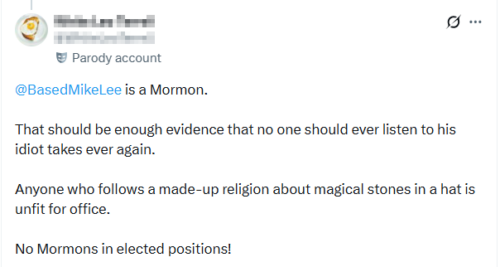


As you can see above, most of such dismissals are a combination of two premises:
- “Mormonism” itself — that is, the doctrine, truth-claims etc. of The Church of Jesus Christ of Latter-day Saints — is self-evidently stupid and unworthy of rational consideration.
- Anyone who believes the self-evidently stupid claims in #1 is therefore self-evidently a stupid person.
This is the informal logical fallacy known as “Appeal to Ridicule,” and the second premise contains more than a whiff of the “No True Scotsman” fallacy as well, which is a form of “Begging the Question”: No sane/intelligent person could believe X, so all of the otherwise demonstrably sane/intelligent people who believe X can be dismissed therefore as NOT sane/intelligent. Every religion, philosophy, or political position has been the subject of such dismissal (yes, even yours).
Obviously, the fact that demonstrably sane/intelligent people accept a contested position as true or plausible — Catholicism, Islam, Trumpism, Keynesian economics, the claim that there’s more than one Highlander movie — does not prove any of those contested ideas true as such. (Several of them are mutually exclusive.) What it does demonstrate is simply that yes, it IS possible for a sane/intelligent person to hold that idea. Some, at best, are objectively true; many will of necessity be objectively false. But none of them are so self-evidently stupid that they cannot bear rational examination or can be dismissed them out of hand.
I hope that I present myself to others as at least a moderately intelligent and reasonable person, so that anyone who knows me would be unwilling to accept Premise #2 in regards to me personally. (Except for you, Sean, but I expect that of you.)
As for #1, whether “Mormonism” is something which can bear rational consideration:
From where I sit in my home office, I can see:
- annotated selections from the diary of Wilford Woodruff (fourth President of the Church)
- three models (in five books) of Book of Mormon geography in the New World
- a volume of academic essays exploring LDS perspectives on the Dead Sea Scrolls
- three books commenting on the place of temples in biblical and Latter-day Saint theology
- a volume relating the work of iconoclastic biblical scholar Margaret Barker to theological undercurrents in the Book of Mormon
- three descriptive works on the formation of “Mormon” culture in the west during the latter half of the 19th century
- a massive academic tome exploring Egyptian initiation rituals in the Book of Breathings from a Latter-day Saint perspective
- two comparisons of Latter-day Saint teachings with ideas found in the apocryphal literature of the 1st-century church
- five biographies of Joseph Smith, of various levels of sympathy
- an edited selection of Joseph Smith’s journals and other writings
- three volumes of academic essays on feature in the Book of Mormon that point to an ancient origin
- two verse-by-verse commentaries on the Book of Mormon (one in four volumes)
- two explorations of symbols used on early Latter-day Saint temples
- a pictorial volume of a plausible route for Lehi’s group from Jerusalem to the shores of the Indian Ocean
- four section-by-section commentaries on the Doctrine & Covenants
- a textual study of the earliest manuscripts of the Book of Moses and Book of Enoch
- collected biographical studies of all the witnesses to to the golden plates
- an early 20th-century ecclesiastical history of the early church from a Latter-day Saint perspective
- a compilation of recorded discourses by Wilford Woodruff
- selections from the 1857 diary of Brigham Young
- selections from the broader journals of Brigham Young
- an examination of the Book of Revelation from a Latter-day Saint perspective
- a book-length academic exploration of the meaning of the Greek word pistis (translated “faith” in the Pauline epistles) in contemporary 1st-century usage and its implications in Latter-day Saint ideas of faith and faithfulness
- a biography of Brigham Young
- a comparison and commentary of Joseph Smith’s different written and second-hand accounts of his First Vision
- a volume of essays about the central role of the testimony of Jesus Christ in the Book of Mormon
- an examination of the split between the Utah-based Church of Jesus Christ of Latter-day Saints and the Missouri-based Reorganized Church of Jesus Christ of Latter Day Saints
- a book about Mormonism and Masonry
- a book on the role of apologetics for Latter-day Saints
- essays on how faith is expressed in the lives of Latter-day Saints
- a selection of teachings from David O. McKay (ninth President of the Church)
- a volume of essays focusing on various parts of 1st Nephi, and another volume for Jacob through Words of Mormon
- a survey of archeological findings by the 1960s, unknown in the 1830s, that corroborate details in the Book of Mormon
- a first-person history of Joseph Smith’s life by his mother
- a response to common anti-Mormon criticisms
- an examination of Lehi’s Old World journey in the light of mid-20th century archaeology
- a compilation of one of several LDS periodicals published in the 19th century
- a compilation of teaching excerpts specifically on the Holy Ghost
- a volume of essays (by reputable geneticists) on what New World genetics do and don’t say about Book of Mormon ancestry
- a seven-volume history of the Church
- a book of academic essays on the U.S. Constitution from a Latter-day Saint perspective
- three volumes of collected miscellaneous research by LDS scholar Hugh Nibley
- a comparison of Jesus as presented in the Gospels with the Jesus found in Latter-day Saint teaching
Plus several devotional volumes, lesson manuals, collections of book reviews, “Mormonism for Dummies,” etc.
And that’s in the broader Christian context of three other Bible translations, four Bible dictionaries/encyclopedias, the translated Nag Hammadi library, a dozen (non-Mormon) volumes collecting various apocrypha and “lost books” of the Bible, a number of C.S. Lewis books, a history of asceticism in the Middle Ages, a few books on comparative religions in the United States, two books with very different takes on UFOs and Christianity, a couple of surveys of post-Temple Jewish mysticism…
(That’s not counting what’s on other shelves in our home, nor is it counting the very estimable collection that my son is building at his house.)
None of this proves that The Church of Jesus Christ of Latter-day Saints is the “true” church, nor is it meant to. What is does prove, however, is that Latter-day Saint thought has sufficient depth to be worthy of study from both inside and outside the Church, and that Latter-day Saints don’t “blindly” believe whatever we’re told to believe with no rational thought involved, and that just dismissing us and our beliefs as “retarded” is meant only to avoid dealing with them head-on.