[Another in the series of “Responding to Bumper Stickers,” or “Long Answers to Short Questions,” in which I try to give a Latter-day Saint response to a question or claim commonly lobbed against us on X.]
I post this not to mock, but to mourn. (And I post it here because screenshots of long threads don’t post well on social media.)

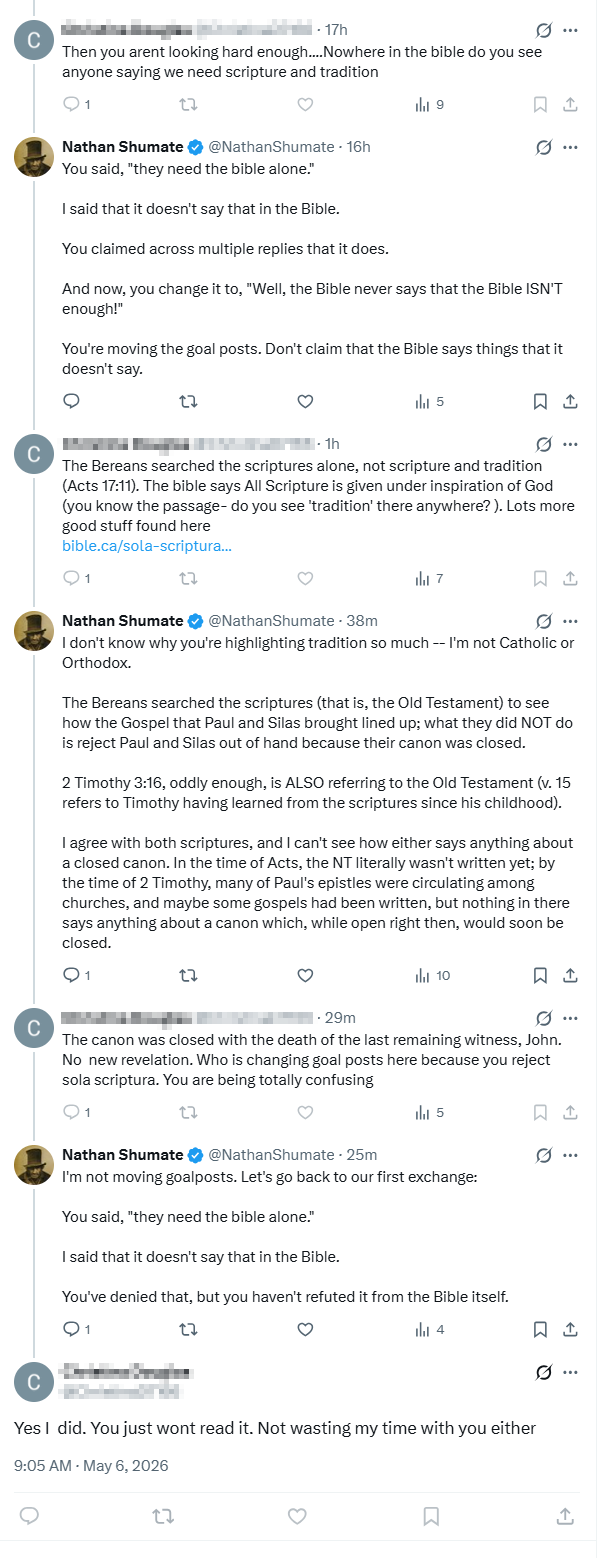
And then, as you can see, I was blocked.
I think the point is fairly simple. If a sola scriptura Christian says that the Bible says something, she should be able to point out where the Bible says that thing. And particularly if a sola scriptura Christian says that “the bible alone” is all you need — a very weighty doctrinal premise — then she should be able to point to that in the Bible. But the Bible doesn’t say that the Bible is a closed canon. It kind of can’t, because the biblia (lit. “books,” i.e., a library) is the compilation made after-the-fact of separate documents often written in ignorance of each other.
She could have said that the Bible is sufficient, for these reasons. I wouldn’t agree with those reasons, but it would be a defensible position in principle.
She could have said that reasoning from the Bible, one reaches a conclusion of a closed canon. Again, I wouldn’t agree, but it’s defensible in principle.
But to claim that the Bible directly says something that it doesn’t say anywhere… That’s simply not something that you can back up. And spinning, moving the goalposts, and eventually just leaving the conversation doesn’t change that fact.
I hope that she takes the occasion to realize her faith in the Bible doesn’t justify her misapprehension of the Bible.
The two passages she did not think to cite to you, which are in fact the basis for limiting all Scripture (i.e. the Bible) to the original Apostles who’d been with our Lord & Savior Yeshua Hanosri (a.k.a. Jesus of Nazareth) in person are in Galatians 1:8-9 in which Paul (who’d been around when Jesus was preaching the original Gospel, though he was among the Pharisees opposing him at the time) warns that even if he and his fellow Apostles or some angel from Heaven came preaching a different Gospel from the ones Christians had already accepted, anyone who did so was eternally condemned (or just plain “damned” as some of our English-speaking Medieval ancestors who were less squeamish about their use of the language might have said) and 2 Timothy 3:15-17 in which Paul laid out that these Gospels they had taught in Scripture (i.e. their writings in which the Gospel they had preached was preserved, and not merely their in-person preaching) was inspired (“breathed”) from God and therefore to be taught to new believers and used to rebuke and correct them if they strayed from its teaching. The Early Church Fathers took these lessons to heart and humbly taught them to new believers later after all the Apostles who’d heard from Jesus in person were gathered to him, making clear that they were not issuing some new Gospel, but were in fact repeating the original Gospel they had received from the original Apostles. In particular, Ignatius of Antioch, a.k.a. Theophorus plainly stated to his Roman flock (in a letter in which he instructed them not to try to rescue him from his pending martyrdom) “I do not, as Peter and Paul, issue commandments unto you.” Let us note this was centuries before the Synod of Laodicea in 363 (which cast out as heretical any and all writings known to contradict the original Gospel the Apostles preached) and the Council of Hippo in 393 (which finalized this original Gospel’s canon).
Moreover, we know from historical context that all these Apostolic documents preserved in canon were not “written in ignorance of each other” as you claim: Peter and Paul and Luke and the other Apostles all met and took council with each other in the times described in Luke’s book of Acts (which may very well have begun as a legal brief to be presented before Nero and the other jurors in Paul’s trial in Rome; Acts 28:21 in particular presents a strong argument for why the charges against Paul should be dismissed, as those who’d first leveled those charges at him couldn’t even be bothered to instruct their colleagues in Rome to be their proxies in taking up their case against him) and then proceeded to send out all their epistles to be read publicly in the various churches (and often, as mentioned in Colossians 4:16, copied and mailed to the other churches for public reading there as well). As Paul himself told King Agrippa in Acts 26:26, none of this stuff was “done in a corner.”
So, no, the Bible does not say “the Bible” is closed canon as “Bible” itself was (as you point out) a term coined considerably later, but rather that “the Gospel” therein is, as stated in Galatians 1:8-9. It does speak quite extensively about Scripture and its sufficiency, however; and Jesus extensively quoted the original Scriptural canon of his time (i.e. the Old Testament) publicly throughout his ministry, even stating in Matthew 5:17-19 and Luke 16:16-17 that it was effectively indestructible. As for the sufficiency thereof, he went so far as to state in his parable about a certain rich man and Lazarus (Luke 16:19-31) that in his time, hearing and obeying “Moses and the Prophets” (verse 29) would be sufficient to save people from going to Hell; and that’s only two out of the three parts of the canonical Tanakh available at the time. In short, God had already provided us with more than enough Scripture even before the New Testament was written, so we certainly ought to consider the Scripture we have to be more than enough now!
It’s also worth recalling that long before Paul gave his warning against “new” Gospels in Galatians 1:8-9, Jesus was already warning us in the 24th chapter of Matthew not to believe or follow numerous false prophets and messiahs who’d be coming to us in his name to lead people astray. In view of how his Apostles and their immediate successors in the Early Church interpreted these statements, and in view of the existing Scripture’s over-abundance of sufficiency, what room can there possibly be for any new Scriptures to be written proclaiming some new Gospel that neither we nor our forefathers ever required? We have no reason and no need to believe or obey the proclamations of a new Gospel from any man or angel, be he Joseph Smith or Moroni—and every reason to reject them for being false as Jesus and his servant Paul commanded us.
There are, however, a number of assumptions in here: Paul himself was not one of the original apostles; he never met Jesus during His mortal ministry, or even during the 40-day ministry. Yet his writings (or those traditionally attributed to him) comprise a quarter of the New Testament. Certainly his teachings and insights were a part of the gospel, but they weren’t clearly elucidated in the gospels, and he even had to contend for them with the other apostles, as they weren’t readily apparent. As I point out in my post specifically about Galatians 1:8, if we interpret the gospel “that which we have preached unto you” to be the totality of what Paul taught in person, then we DON’T KNOW wholly what he taught, as the epistles aren’t a rehash of all of his in-person teachings; if we interpret that gospel to simply be what he gives in capsule form in Galatians 2:16, then he can’t be said to be condemning teachings which expand the understanding of, but don’t contradict, that capsule description.
As I pointed out in the X thread reproduced above, 2 Timothy 3:16 is referring almost entirely to the OT, not to the circulating texts which would someday form the NT, as these were things which Timothy had learned since his childhood.
When I say “written in ignorance of each other,” I don’t mean that each apostle was teaching an entirely unrelated strain of Christianity, but simply that they were not a coordinated effort — “you explain that doctrine, I’ll explain this doctrine,” etc. Instead, Peter didn’t know what was in Paul’s epistles before they went out, and Paul didn’t know what was in James’, and so on. (One would assume that, had Paul and James been in consultation, they would have agreed to what they commonly meant by “faith” and “works” so that the surface contradictions wouldn’t confuse Christians for 2,000 years.) Neither the epistles nor, to a lesser degree, the gospels were a systematic explication of Christian theology and practice, but ad hoc instructions to various congregations which built upon a grounding of original in-person teachings which we just don’t have.
I don’t think you caught a contradiction in what you wrote. If, as you say, “God had already provided us with more than enough Scripture even before the New Testament was written,” then what IS the utility of the NT? If the OT is sufficient, then the NT is an example that further scripture can be instructive and valuable without being minimally necessary — in which case, it doesn’t make sense to limit the canon ONLY to the NT.
I’m really tight on time this week (I’m at a writing retreat), but please respond if you want me to explain later anything in this response, or if I’ve left unanswered anything in your comment that you think deserves a response.
For starters, even leaving aside his personal encounter with Jesus on the road to Damascus, the Apostle Paul did in fact meet him in person during his ministry here on Earth as well—just on the other side, as he was most certainly among the Pharisees arguing with him and looking to put him to death. He was after all a “Hebrew’s Hebrew” as he explains at some length in the third chapter of his letter to the Philippians, and hence a Pharisee’s Pharisee who’d been just as zealous in persecuting Jesus and his followers as he would later be in promoting the Gospel thereof. Among other things, this is likely how he happened to know about Jesus having said “It is more blessed to give than to receive” at some point in his ministry as mentioned in Acts 20:35, something none of the other Apostles ever told us in any of their writings on our Lord & Savior.
As to “writing in ignorance” of each other, it’s true that the Apostles weren’t systemically coordinating their efforts, as you say. What I mean is they surely weren’t ignorant of what the others were teaching, as their letters were being circulated and read aloud at the various churches, and the believers there were in turn writing back to the Apostles from time to time to tell them about what was happening in their locale and ask about certain controversies and problems that had arisen among them. If the believers who’d read the letter from James had seen in it any apparent contradictions of Paul’s teaching that grace through faith rather than works is what saves us, surely somebody from any the many churches who’d circulated both men’s letters to each other would have written something to Paul about it, e.g. “But Paul, Jesus’ brother James told us that without works, our faith is dead! How does that square with your teaching that we are saved only by grace through faith, and not by works?” As limited as the communications technology of the time was, those limitations didn’t keep the Apostles ignorant of what their fellow Apostles were saying and doing elsewhere.
While the epistles certainly were “ad hoc instructions” to the believers as you say (though they were also recording and preserving those in-person teachings, not just building on them as you claim), the four Gospels—particularly John’s, as he explicitly states in 30:30-31—were in fact systemically laying out Jesus’ doctrine. They each did so by their own methods: Matthew’s semi-chronological approach which reads something like an accountant’s records or a lawyer’s testimony in court about what a defending or prosecuting party has been doing (as is fitting for a former tax collector), Mark’s action-packed account that focuses more on the actions than the statements from Jesus and the people around him during his ministry, Luke’s more meticulously chronological approach—similar to that of the Roman historian Tacitus—in which he lays out what happened from the time Jesus was conceived on up to the end of his earthly ministry, and John’s biographical approach—similar to that of the Roman biographer Suetonius—in which he focuses on what Jesus was like and what the far-reaching eternal implications of the things he said and did were for true believers. Like Exodus in the Old Testament, their four Gospels (or Evangelia as they’d be known to Latin-speaking believers such as Luke’s Roman sponsor Theophilus) and Luke’s followup book of Acts were written partially as history, and partially for doctrinal purposes.
As for all the letters after that, they’re more like the books of the Prophets from the Old Testament, which built on the original Torah the Jews had received from Moses when God sent various prophets to tell the people how they were disobeying these Scriptures, how they needed to start obeying them again, and the dire consequences that would follow if they didn’t. The reason the New Testament doesn’t have any books that systemically lay down God’s Law the way Leviticus and Deuteronomy (especially) did is because Jesus wasn’t bringing us any new additions or extensions to the Law as laid out in the Torah, and was not looking to abolish it so it could be replaced, but rather fulfilling it (as stated in Matthew 5:17) by obeying it completely as our sinful ancestors had been unable to do. This is also why the New Testament doesn’t really have anything comparable to the Ketuvim (“Writings”) from the Tanakh like Ruth or Esther: while true believers would go on to have many new life’s stories to tell as a witness to the faith, God the Son was not establishing any new nation or political entity here on Earth as God the Son had with Israel; as we did not need a new Law, neither did we need any new books telling of how that Law was applied in the nation established upon it.
Speaking of the Old Testament, no I was not contradicting myself when I pointed out Jesus had stated in his parable about the rich man & Lazarus that Moses and the Prophets were enough to save a man from going to Hell. Up to the time when Jesus completed his ministry here on Earth and returned to Heaven, believing and obeying those books was indeed enough—and in fact, more than enough—to save a man from Hell, as they told people everything God required of them. The reason we needed any New Testament at all—and I should point out people were believing and obeying Jesus and being saved before a single page of it was written—is because those Old Testament writings one had to believe and obey to be saved were all written in anticipation of the coming of this Messiah to set right what had gone wrong all the way back in the opening chapters of Genesis; once the anticipated Messiah arrived, one’s belief and obedience to these anticipations were now transferred to that Messiah. This is also why Jews nowadays who claim to believe Moses and the Prophets and yet do not accept that Jesus (Y’shua in their original Hebrew) is that promised Messiah are not saved: if you claim to believe and obey Scripture and yet reject the one who fulfills that Scripture’s promises, you’re not really believing and obeying it, are you?
Then too, now that the promised Messiah has come—and gone—and promised to return someday—one no longer needs to know about those previous promises to believe in and obey that Messiah and his current promises; which is one reason the Gideons (of whom my father is a member, incidentally) go around handing out pocket-sized copies of the New Testament as well as placing full editions of the Bible in hotels and hospitals and the like. They’re not Marcionite heretics, disavowing that our God is the God of both the Old and the New Testaments; they’re just making the most of their limited resources to get what little Scripture is necessary to believe and obey into people’s hands. They and I and all other true believers would certainly like everybody to get their hands on a full edition in their native language to read and study and believe and obey, but reading and studying the entire written Word of God is not absolutely necessary to believing and obeying that Word made flesh in Jesus Christ.
Moreover, those Epistles are not “built upon a grounding of original in-person teachings which we just don’t have” as you claim, but are records the Apostles made of the doctrines they were teaching both in-person and by correspondence so that we future believers would have them available to us. Those in turn were founded on the in-person teachings from our Messiah which they also recorded so as to preserve them for us here in the future, and those teachings in turn are all founded firmly on the Old Testament, from which he and the Apostles all quoted and taught extensively. None of what they were teaching was by any means a pure novelty to any of the new believers who were familiar with the Tanakh.
Again, when I say that the Scripture they had—and now the Scripture we have—is more than enough, that doesn’t mean we have any right to try dispose of the parts that aren’t necessary to our salvation and pretend they never happened as the heretical Marcion of Sinope and his followers tried to do; but that also doesn’t make the New Testament a mere “supplement” to the Old Testament, nor unnecessary to our salvation now. It merely means that one doesn’t have to be an exhaustively educated scholar of Scripture to believe and obey it, i.e. you don’t have to be fluent in and understand all the finer nuances of Hebrew and Aramaic and Greek and Latin and have read and understood every last verse of every book in the Bible (including Zephaniah; ever hear about that guy’s book in a Sunday School class?) in their original languages to be faithful. Undoubtedly, the Talmudic scholars who bickered endlessly over the most trivial points of the Tanakh would have a field day trying to determine what the absolute minimum of Scripture one has to believe and obey to be a true believer (and therefore saved) is, but it should suffice to say that God has always given us and our predecessors more than enough.
In any case, what this all means is that we don’t need another Gospel, and we’ve never needed another Gospel. That’s something the Early Church fathers clearly understood from the start, and why they did not attempt to add any more books to Scripture after the Apostles died (which is why there’s no book of Theophorus, or Iranaeus, or Clement, or Didache or Tertullian, or Polycarp, or Valentinus, or Ambrose, or Chrysostom, or… etc. in the Bible). That the Roman Catholic Church (which was never as “catholic” [i.e. “universal”] as it claimed) was trying to add its own ecclesial and Papal authorities to Scripture’s authority was what ultimately led to the Reformation, as Martin Luther & company came to realize Scripture and those Early Church fathers had warned us against this very kind of blasphemous usurpation of the Word of God’s authority.
As for Joseph Smith and some angel named Moroni allegedly providing him with new volumes of Scripture on golden tablets he’d buried back in 421 AD—even leaving aside the extremely dubious veracity of his claims—if you’ve been studying and teaching from your church’s canon for so very long, surely you’re aware this new Gospel your church proclaimed a part of its canon includes not only the Book of Mormon as inscribed on those tablets, but also Doctrines & Covenants and Pearl of Great Price, which were written later entirely based on alleged personal revelations to Joseph Smith and some of his successors? As the only part of your church’s canon I’ve ever had is that Book of Mormon your missionaries regularly hand out (as they did to my father decades ago when he was a college professor, which is how I came to have a copy), I can’t vouch for any of my fellow skeptics’ claims, but they’re telling me that these other books are allegedly the ones that push such heretical doctrines as e.g. that “salvation by works” doctrine you denied in an earlier article, and a rather Gnostic-sounding claim that Jesus was not God the Son, but rather one of the angels, and that as such Lucifer was one of his brothers.
Even if these are not a part of your canon, however, these books are clearly a new Gospel, not a mere “supplement” to the old; and I can no more accept adding them to the original Gospel the Apostles brought us than I could a Marcionite or Pelagian or Gnostic or any other kind of new Gospel.
Contrary to your claim that Paul was “most certainly among among the Pharisees arguing with him,” I have never heard anyone (of any flavor of Christianity) even suggest that Paul might have met Jesus prior to the latter’s crucifixion. That seems to be something that would have been mentioned, or or at least alluded to, in Acts, or in Paul’s own castigation of himself in his role persecuting the Christians.
If the gospels were laying out Jesus’ doctrine systematically, there would have been no controversies leading to the formulation of the creeds centuries later.
The epistles very clearly are NOT “records the Apostles made of the doctrines they were teaching,” at least not in any depth. They were not rehearsals of what they had already taught the congregations in person; they very much present themselves either as general devotional messages, or as answers to specific issues or questions that specific congregations had. There is simply no reason to conclude that the roughly 50,000 words of the epistles contain all the inspired teachings of decades of the apostles’ in-person ministries, or especially that the decades of ministry from the eleven apostles who had accompanied the mortal Messiah and then were taught by Him for 40 days after His resurrection could be condensed down to less than 10,000 words in epistles split between four apostles.
Of course we don’t need another Gospel; but just as a first-century Christian Corinthian wouldn’t turn up his nose at a second epistle from Paul, I will always be eager for God to reveal more, to explain more (just think of how the history of Christendom would have been different if controversies hadn’t been left hanging), and to give guidance specifically for right here and right now.
Now, this conversation has been mostly respectful up to this point, and we have been long-time shoulder-rubbers in other internet contexts, so please understand that I’m not trying to wax belligerent, but I hope you realize just how insulting it comes across when you try to explain the “surely you’re aware” facets of my own faith that I have studied for decades? Especially when you admit that you don’t have first-hand knowledge and you’re not sure what I consider canon, but that you’re ready to throw second-hand understandings of my own scriptures at me? Will you at least do me the basic courtesy is that I am more of an expert in what I’ve immersed myself in for decades than what you’ve just heard from some guy?
The point of the original post to which you responded, in case it’s been forgotten, is here:
***
She could have said that the Bible is sufficient, for these reasons. I wouldn’t agree with those reasons, but it would be a defensible position in principle.
She could have said that reasoning from the Bible, one reaches a conclusion of a closed canon. Again, I wouldn’t agree, but it’s defensible in principle.
But to claim that the Bible directly says something that it doesn’t say anywhere… That’s simply not something that you can back up. And spinning, moving the goalposts, and eventually just leaving the conversation doesn’t change that fact.
Well, given that Paul’s life prior to his experience on the road to Damascus isn’t exactly a hot topic for discussion in home Bible studies or in online Christian forums, I’m not surprised you’ve never heard any professed Christians of any stripe mention the likelihood of his having met Jesus in person at the time before; but it has in fact come up on occasion. On gotquestions.org in particular (one of the first several results to come up if you ask DuckDuckGo questions about Biblical subjects), there’s a whole page offering several compelling bits of evidence for Paul having had both the means and the motive to have encountered Jesus in person during his ministry, especially while he was in Jerusalem. Paul and his family were raised there, he was a Pharisee’s Pharisee with a zeal for enforcing the Law, and such a zeal would certainly have brought him into conflict with (as he and many of his fellow Pharisees saw them) the controversial and quite possibly heretical teachings of an upstart rabbi.
To the evidences presented there, I reiterate the point of where exactly Paul (in Acts 20:35) heard of Jesus saying “It is more blessed to give than to receive” during his ministry: sure, one of Jesus’ original Disciples might have told him, or this might simply have been common knowledge among believers at the time, but if so, wouldn’t at least one of those other Apostles have thought it important enough to mention in their Gospels? In addition to Paul’s being a “Pharisee’s Pharisee” as mentioned, I would point out one of the credentials he mentions in Acts 22:3 was being brought up “at the feet of Gamaliel” as his religious mentor. His mentor’s mentor was the famous Rabbi Hillel who’d regularly bickered with his rival the Rabbi Shammai about (among other things) a subject that the Pharisees would bring up to Jesus in Matthew 19:3 when they were challenging him in front the crowds following him: could a man lawfully divorce his wife for any and every reason? Considering that Gamaliel would certainly have taught Paul about his mentor’s famous answer (“Yes, he could divorce her even just because she burned his supper!”) and Shammai’s famous contention to the contrary (“No, he shouldn’t divorce her for any transgression less serious than adultery!”), one can be sure he’d be quite curious to know where so popular and controversial a public figure as this upstart new rabbi stood on this hot-topic issue of his time (and maybe a little miffed to know he mostly sided with the rival school’s teachings on it).
So… are these absolute proofs that Paul and Jesus crossed paths in person at some point during the latter’s ministry? No, since it’s always possible that Paul—either by chance, or by deliberately going out of his way—never hung around the parts of Jerusalem and the Judean countryside where Jesus was preaching to the crowds. Still, these points all stand as pretty strong evidence for a personal encounter: how likely is it that so zealous a keeper of the Law as Paul would be utterly uninterested in getting a closer look at a controversial man who inspired so much belligerent interest from his colleagues to—if for no other reason—size up an enemy and potential threat to his fellow Pharisees and himself? Remember, none of this was “done in a corner.” (Acts 26:26)
As for the nature of the Gospels and subsequent Epistles, when I say they were records of the Apostles’ teachings, I don’t mean they were “systematic” as you seem to think it so important for doctrinal teachings to be. These were not like e.g. Leviticus and Deuteronomy in the Old Testament which—although our chapter-and-verse numbering system for Bible books wasn’t actually introduced until King James’ time—the Hebrew Scribes of old regularly studied and cited in their arguments as systematically as any contemporary lawyers study and cite their law books in courts today. As John in particular made abundantly clear at the very end of his Gospel (21:25), they were in fact quite selective, not even attempting to be exhaustive in their examination of everything Jesus had ever done or said in his life.
A very important point Jesus made during his ministry here—which was not at all coincidentally the one teaching of his that offended the various religious authorities the most—was that in all their meticulous and systematic studying (and arguing down to the finest points) of the letter of this Law that God the Father had handed down to them through Moses some two millennia ago, the authorities and laity alike had neglected to follow the spirit in which his Father had given them that Law, i.e. God’s intention that they practice the kind of mercy and justice and faithfulness that are pleasing to Him in accord with His instructions, and not merely go through the motions of practicing the religious rites prescribed therein with no true love for the God who prescribed them and therefore no actual desire to please Him at all (Matthew 23:23-24, 15:7-9).
From the dawn of time, the common desire to which all man-made (and therefore false) religions have catered is the desire to have a cut-and-dried list of rules believers can systematically follow to the effect of “If you do these things your god tells you to and avoid doing these other things he tells you not to, and if you pay some of kind of dues to compensate for your sins (giving money, making a sacrifice, doing penance, etc.) whenever you do screw up, your god will bless you and you’ll prosper in this life and maybe some kind of afterlife too.” From His chosen people’s very origin back in Abraham’s day, God was looking to get them away from that worldly mindset and get them focused on having a loving personal relationship with Him instead. Also, the kind of love He was seeking from them was not some fleeting warm-and-fuzzy feeling of affection such as even a great many animals have for each other, but an abiding covenantal and familial love such as husbands and wives and parents and their children have for each other.
Hence, while Jesus and the Apostles taught a great many doctrines and even laid out some systematic instructions on how to deal with certain situations (e.g. the process for dealing with a wayward fellow disciple Jesus taught us in Matthew 18:15-17), at no point did they ever intend to give us another law book for us to twist into another cut-and-dried list of rules for yet another man-made ritualistic religion as our wayward spiritual forefathers in Israel had done. The reason for this was two-fold:
A: We already had God’s books of Law in the Torah, and Jesus came to fulfill that Law, not augment or replace it.
B: If anything, what our forefathers did with it only served to demonstrate how impossible it is for us inherently sinful people to keep from breaking it (as Paul lays out in depth in the rather lengthy theological treatise that—apart from some greetings and salutations at its beginning and end—is pretty much his entire friggin’ letter to the Romans).
So no, the Epistles are not “systematic” books of doctrine by your definition; and they’re certainly not an exhaustive account of everything Jesus—let alone his Apostles—ever did and said. As John says in that last verse of his Gospel, if they were that exhaustive, we could fill the world to overflowing with all the books that could be written; and from all the scholarly ink that’s been spilled over those four Gospels alone over the past two millennia since, we can see that his statement there was only barely hyperbole. Nevertheless, that doesn’t stop them from being records of what the Apostles were consistently teaching.
As I said when talking about how the Old Testament and New Testament have each in turn been more than sufficient for our salvation, one doesn’t need to have an exhaustive knowledge of Scripture to believe and obey it. By the same principle, we don’t need an exhaustive account of everything Jesus did and said in his lifetime—every meal he ate, every place he slept at night, every time he used an outhouse or public latrine, and all his activities with his family during his infancy, childhood, adolescence, and new adult years, etc. in order to believe and obey him. Whether on paper or in the flesh, God’s Word is more than sufficient for our salvation even with all this conservation of detail.
(Incidentally, what inspired me to write that bit about our Lord & Savior using sanitary facilities was the original novel of The Neverending Story‘s, which mentions in passing that its protagonist Bastian once got scolded by a schoolmaster who was teaching a class in Christian doctrine, and specifically explaining the one about how Jesus was—and is—both fully God and fully man. His curiosity piqued, the somewhat socially inept Bastian then innocently asked him whether that meant Jesus had to use the bathroom then, which made his classmates laugh; and the schoolmaster, figuring the kid was just being bratty and mocking him to win his classmates’ approval, chewed him out for asking such an impertinent question. Had I been in said schoolmaster’s place and realized the question was asked in good faith, my answer would have been “Well, yes, but nobody ever wrote about that because it’s not really important. See?”)
While not “systemic” and not exhaustive, those Gospels and Epistles were quite intricate and in-depth in what doctrines they did teach; and in many cases, that intricacy actually required some conservation of detail. Paul’s letter to the Colossians, for instance, is all about combating certain heretical beliefs that had arisen in Colossae at the time and were corrupting some of the believers there. What exactly those beliefs were, Paul didn’t bother to elaborate, which has had various theological scholars arguing over what exactly the “Colossian Heresy” (as they refer to it) was and who was promoting it.
My speculation is that the Colossian Heresy wasn’t actually any single unified religious movement as many of these scholars believe, but rather a number of different heresies arising from multiple sources that weren’t deliberately coordinating with each other at all. The reason Paul didn’t try to debunk and refute each one separately is that like the heads of the hydra, any time he successfully destroyed one such heresy with a carefully reasoned argument, other slightly different heresies could easily arise to take its place. Instead, evidently figuring that the best offense against heresies was a good defense of the true faith, he launched into an explanation of what the true faith is and why it is more than sufficient to our salvation and cannot be improved and we therefore should accept no add-ons and no substitutes.
The divinely inspired genius of this approach is that it would continue to be applicable down through the centuries and millennia whenever some other heresy and heretical group slightly different from the ones before it arose to lead more believers astray (e.g. the Manicheans who initially snared Augustine of Hippo with their dualistic brand of Gnosticism in the fourth century). One of the heresies refuted, in fact, was probably some early prototype of Gnosticism that denied Jesus was fully God; in later centuries, other stripes of Gnosticism would teach that he was fully God, but not fully man (because how could something so inherently sinful as the human body be a vessel for God’s perfect divinity?) or that he was neither fully God nor fully man, but a fifty-fifty hybrid of each. Though Paul had long since been martyred in Nero’s time by then, his letter to the Colossians (which like all his other epistles was to be shared with other churches and read aloud in each) continued to protect those who heeded its record of his teachings on this subject from being taken captive by the fine-sounding hollow and deceptive philosophies of ascetics and angel worshipers and legalists and Judaizers and Gnostics promising secret knowledge (i.e. gnosis) that would supposedly make those who learned it “superior” to other Christians and the like.
In fact, the doctrines Paul explained in that epistle continue to stand fast against various contemporary heresies: for instance, like the Gnostics before them, the Freemasons claim to have secret knowledge that will make those who learn it superior (and layers upon layers of it to learn to raise you through each of their many ranks). Like the angel worshipers of Colossae before them, the Jehovah’s Witnesses claim Jesus is not God the Son, but actually the archangel Michael who is God’s highest created being. Like the ascetics and legalists, the Seventh Day Adventists insist that one must abstain from eating certain foods and keep certain days holy (specifically, Saturdays as the Sabbath) in order to be a faithful Christian; and oddly—like Jehovah’s Witnesses—they identify Jesus as the archangel Michael, but—unlike Jehovah’s Witnesses—as also being God the Son. (The idea, I think, is that Michael’s a name and “archangel” a title he uses when commanding those angels.)
Now please understand, when I said after studying your church’s doctrine all this time, you’re surely aware your church’s canon consists of more than just the Book of Mormon, I was not trying to insult your intelligence and argue in bad faith by trying to put any words in your mouth to mischaracterize what you and your fellow Mormons believe. I likewise presume you were arguing in good faith when you thought you had spotted a logical contradiction in my claims about the Old and New Testaments’ sufficiency. What I was doing was asking the expert who presumably has access to these other books in his canon to enlighten yours truly who is ignorant of what’s actually in those books because I do not.
The reason I asked about these disturbing rumors—or “second-hand understandings” as you put it—about those books’ contents is because I want to hear what your expert understanding of the doctrines and revelations therein is. That “some guy” from whom I heard these rumors? It’s probably some several guys, actually, as it’s actually from some site: remember that gotquestions.org site I mentioned up above? Yeah, it’s the one making these claims about what’s in those other books.
So let’s hear your expert explanation: what do the passages from those books referenced on the page actually say? Has that page mischaracterized any of what they say, or why your missionaries aren’t handing them out along with the Book of Mormon (of which it actually says “In fact, there is really very little in that book that is doctrinally disagreeable to orthodox Christians.”)? I know militantly anti-Christian atheists sometimes defame the Gideons as pulling a kind of doctrinal “bait and switch” by handing out those pocket Testaments, saying that our potential proselytes would never “fall for” our religion if my father and his fellow Gideons were handing out full editions of the Bible with all those grimmer and darker and decidedly less family-friendly parts of the Old Testament such as the book of Judges in them (even though, as I say, the Gideons pretty much do try to distribute those as well, albeit mostly in hotel rooms and the like since they’re not quite as immediately portable).
Is that site libeling Joseph Smith when it claims he was a polytheist? Did he make false prophecies about New York and the Civil War (or “War Between the States” as a lot of people were calling it then and as some still do nowadays) as it says? Does the Mormon Gospel claim that God was once just a man, that Jesus and Satan were brothers, or that upon completing a multitude of various good works prescribed in this canon that one can “attain to the third and highest level of heaven, thus achieving the ultimate goal of the Mormon gospel—godhood” anywhere in it?
As I say, maybe these are all lies or deceptions born of wrenching certain passages in your church’s canon wildly out of context and mashing them up in ways they were never relevant to each other. If so, I’d like to know what they actually say and mean in context. Since you’ve been studying these canonical works to which I don’t have access for so long, I’m dead certain you are more of an expert on these subjects than I am; but do you know more and better about them than these guys?
Concerning the point of the original post, well, that site also has a page about the closing of the canon, although if I were to post a third direct link to it from this comment, experience reminds me your spam filter would likely automatically kick it into moderation limbo for seeming too much like an advertisement for other sites. Suffice to say, at either of the two links I’ve provided to gotquestions.org already, you can just look up “closed canon” in the search bar at the top, and you’ll spot that third page almost immediately. For the record, however, in addition to that Galatians 1:8-9 passage, the site also points to Jude 1:3, Proverbs 30:5–6, Deuteronomy 4:2, Deuteronomy 12:32, Revelation 22:18–19, and 2 Peter 1:3 as statements indicating God has given us all the commands and Gospel we need, and does not hold out any further promises and offers to add any more.
Of course, one reason this discussion has ranged to so many other topics besides the original is that your posts on various subjects since then have all been interrelated with this one in various ways. Concerning your most recent post on whether Mormons are dispensationalists, it might interest you to know the first church at which I was a member and which my family regularly attended until we moved away from Minnesota when I was ten was in fact an Evangelical Dispensationalist church, and even after we moved to North Carolina, my mother taught me its many doctrines as she home schooled me through high school. (The churches we attended in North Carolina have mostly been some variation of the Southern Baptists, these being the most common and widely attended in the entire region and there not exactly being a lot of Evangelical and Dispensational churches anywhere near the places where we’ve been living in the state.)
Obviously, you’re not big “D” official Dispensationalists, as you never claimed to be in any way associated with our denomination; but one could certainly make the case that you’re small “d” dispensationalists for believing in these various divisions between eras brought by God dispensing new instructions on how we are to live our daily lives and how we are to worship Him. Of course, you also immediately notice professing Christians of just about every stripe aren’t sacrificing animals on altars or restricting their meat consumption to land animals with divided hooves who chew the cud and seafood that comes with fins and scales as commanded of our Jewish predecessors in the Mosaic Law; at the very least, one could say all Christians are dispensationalists (but not so many necessarily Dispensationalists) in the sense that we all believe God has dispensed instructions freeing us from these ceremonial and dietary restrictions and requirements of that Law.
All of this feeds back into the doctrine that the Bible is indeed a closed canon, however, as among the Dispensational doctrines my mother taught me is that Paul was speaking in 1 Corinthians 13:8-13 of a new dispensation to be given to the Early Church after all the Apostles were gathered to God: a time in which prophecies would cease, tongues be stilled, and knowledge (revelations?) pass away. We know from historical records of the Early Church that there were indeed prophets and people miraculously speaking in tongues they couldn’t have learned naturally (as first happened during Pentecost in Acts 5:2-11), but also that soon after the Apostles were gone and as time carried on, these individuals began to fade away, and their successors (e.g. Theophorus, as mentioned) humbly admitted they had none of this special knowledge (revelation?) God had dispensed to the Apostles.
The reason Revelation is the last book in the Bible is not just because it speaks of the End Times, but because the Apostle John who wrote it was also the very last one to die; every other Apostle had already been martyred (most of them somewhere in Rome, but later Christian missionaries discovered Thomas had made his way down the Silk Road all the way to India and been martyred there, as they found a sizeable community of Christians already established there when they arrived to proselytize the locals). John was the only one who died in his bed of old age rather than any of his many persecutors executing him, and if the Early Church Fathers’ stories are to be believed, this wasn’t because they weren’t trying!
Anyway, after John died, the reports of the remaining believers from the Apostles’ generation doing miraculous things like that tapered off, so Paul’s prophesied fading away of prophecies, tongues, and that special knowledge evidently came true. With the closing of that early dispensation, there were no more prophets and nobody with any of that miraculously granted supernatural knowledge of any kind; each of whom were the kind of people God exclusively had writing the rest of the Old Testament after the Torah was completed. When there were no more of these, there was no further Scripture to write, as prophesied.
So what you’re saying is that it’s *plausible* or *arguable* that Paul could have been among those arguing against Jesus face-to-face. I could accept that as an interesting hypothetical. That’s still a qualitatively different statement than saying that he was “most certainly among the Pharisees arguing with him and looking to put him to death.”
You spent quite a few words here arguing against the need for a systematic doctrinal statement in the NT, which is fine, except you were the one who said that “the four Gospels … were in fact systemically laying out Jesus’ doctrine.” Which leaves my contentions unanswered: If the gospels were laying out Jesus’ doctrine systematically, there would have been no controversies leading to the formulation of the creeds centuries later.
Instead, we DO have a council of men hundred of years later coming up a list of core doctrines by committee, using language not found in the NT, but declaring that their formulation is authoritative.
To answer your specific questions about LDS doctrine:
Is that site libeling Joseph Smith when it claims he was a polytheist?
It depends what you mean by polytheist.
Do we believe in a “pantheon,” such as most pre-Christian religions did? Absolutely not.
Do we believe that the Father, Son and Holy Ghost are three separate beings? Yes.
Do we believe that there may be completely separate creations which would have completely separate gods? Sure, but in any practical terms it’s academic and speculative as there’s literally no overlap in reality — we have one Father, and the possible existence of others somewhere out in the “multiverse” makes no difference.
Did he make false prophecies about New York and the Civil War (or “War Between the States” as a lot of people were calling it then and as some still do nowadays) as it says?
The New York prophecy referenced is in D&C 84:114-115 is the the effect that if the great cities in New York State doesn’t repent, “their house shall be left unto them desolate.” I haven’t seen that happen yet. But “yet” is a big qualifier in prophecies — there are all sorts of prophecies from the OT that haven’t been fulfilled yet either.
The Civil War prophecy is all in D&C 87; it’s a little long to copy-and-paste in here, but I don’t see any great error in it.
Does the Mormon Gospel claim that God was once just a man,
I would argue against the word “just” — God the Father has promised the faithful that they may become “heirs of God and joint-heirs with Christ,” who receives all that the Father has. We believe that God calls Himself our Father for literal reasons — that He’s not just calling Himself that in the sense that people call themselves “pet parents” to “fur babies” — and that His ultimate goal, like any parent, is for us to become as He is. With that context, it’s reasonable to presume that God Himself was once in the same position, in the unfathomable past in a completely separate creation.
that Jesus and Satan were brothers,
I wrote a whole post on that: https://nathanshumate.com/jesus-and-satan/
or that upon completing a multitude of various good works prescribed in this canon that one can “attain to the third and highest level of heaven, thus achieving the ultimate goal of the Mormon gospel—godhood” anywhere in it?
It’s not “completing a multitude of various good works” (even though good works should not be pooh-poohed, as Revelation 20:12 says we’ll be judged by them), but by making and keeping covenants with God. As Hebrews makes clear all through the book, doing what God wants you to do is what “faithfulness” is.
Getting back once more to the original post, again: One can argue for the necessity of a closed canon, and that’s a big and meaty discussion, and people of good faith can argue both sides, as you and I keep doing. But one can’t claim point-blank that the Bible says that the canon is closed.
I’m seriously puzzled that you would include Proverbs 30:5-6 or Deuteronomy 4:2 or 12:32 to support a closed canon. Either those verses mean that the canon was closed AT THAT TIME, so nothing in scripture past either of those points is legitimate; or that neither one precludes God giving further scripture, which then can’t be used to argue that the canon was necessarily closed in NT times. I don’t think Jude 1:3 or 1 Peter 1:3 are making the point that you say they’re making, and we both know that Revelation 22:18-19 are referring to THIS SCROLL (“book”), i.e., the Book of Revelation, not the library of writings that will be compiled centuries in the future.
I’m not speaking against your mother, but I don’t agree with her interpretation of 1 Corinthians 13:8-13. I understand Paul to be saying simply that nothing is as permanent as God’s love.
And I would never interpret the end of miracles as something God intended; God is still a God of miracles, and the reason that miracles and revelations dried up in the church is largely the same reason that Jesus Himself could do no mighty works in Nazareth when he returned.
What I’m saying is it seems to me with Saul (later known as Paul) and his family living in and around Jerusalem at the time when Jesus was going around and creating quite a public stir with his controversial statements, it’s far more likely than not that he was there. It’s always possible that he somehow happened to be out of town every time Jesus was in town (even though most of those occasions were around popular religious holidays when one would expect more devout Jews like Saul to want to be in town more) or that he despised him so much for his sharp-tongued rhetoric against the religious leadership (such as the Pharisees) that he didn’t even want to be in the same public square as this jerk he felt was personally attacking him along with the other Pharisees; but then again, how many Jews in general—let alone the Pharisees—would actually find the prospect of getting into a bickering match with this upstart rabbi repellent rather than intriguing? Maybe I should start putting an apostrophe in front of the word “most” when I say something is “most certain” to indicate I actually mean it’s almost certain; that the inverse is a possibility, but not a very likely one.
They were contemporaries, they spent their time in many of the same areas of Judea, and the Pharisees with whom Saul of Tarsus regularly rubbed shoulders weren’t shy about challenging Jesus over various doctrinal issues in front of the crowds of people following him around. Even if—for that matter—Saul maybe kept quiet and let his elders do the talking, why wouldn’t he go with them when they were out there challenging Jesus? Again, while there’s no absolute certainty they met face to face, the circumstantial evidence strongly favors Saul and Jesus encountering each other in some way during the latter’s ministry, even if only in passing.
When I said the four Gospels—and the Epistles—laid out Christ’s (and Christianity’s) doctrines systemically, I mean they were written in various systemic ways. The trouble with the word “systemically” is that its definition is rather slippery and can be applied a great many different ways. Moreover, when one is speaking of doctrines involving something more than just cut-and-dried factual claims and cold hard logical philosophical reasoning from them, there’s some question of what it means to be “systemic” in laying them out.
As mentioned, systemically laying out laws as done in Leviticus and Deuteronomy (and to an extent in Exodus and Numbers as well) is easy: “God says do these things, don’t do those things, here’s how you’ll benefit if you do as commanded, and here are the penalties and punishments you’ll suffer if you disobey.” Systemically laying out logical philosophical arguments takes some education and finesse, but Paul had plenty of both when giving his long theological treatise in his letter to the Romans, in which he used the classic rabbinic style of rhetoric he’d learned as a Pharisee: ask a question, give an answer, raise another question that this answer might inspire one’s listeners to ask, and then answer that; rinse, wash, and repeat. The real trouble with being systemic is when the doctrine has to do with more subjective topics like love and relationships, e.g. “Love YHWH your God with all your heart and all your soul and with all your strength.” (Deuteronomy 6:5, which Jesus said is the greatest commandment) and “Love your neighbor as yourself.” (Leviticus 19:18, which is the second greatest) and Jesus said in Matthew 22:40 that all the Law and the Prophets hang on these two commandments.
All right… so how does one systemically lay out what this doctrine of his means? Love isn’t some cut-and-dried belief system, you know. Jesus wasn’t saying if you follow entirety of the Law found in the Torah to the letter, you’ll be keeping these two commandments: if anything, he regularly excoriated the religious leaders of his time for following the entire rest of the Law to the letter while (consequently) disobeying these two greatest commandments because they weren’t going through their ritualistic motions of obeying the Law out of any actual love for God and their neighbors.
How does one systemically lay out any kind of relationship? I know one can systemically lay out e.g. a romance novel. I remember my late mother once telling me back when I was fresh out of college that she’d gotten occasional offers in the mail from Christian publishing houses seeking for authors to do just that: follow the formula in the instructions the publisher sends you which tell you to have the romantic couple meet in such-and-such a situation to fall in love and then have to overcome such-and-such an obstacle to stick together and ultimately get married at the end; now that I think of it, those companies might just be getting AI to write these “mad libs” style formulaic romance novels for them as a cost-cutting measure soon if they aren’t doing so already these days.
However, how does one systemically lay out the romance itself? There’s no such formulaic instruction manual in real life to tell you if you make sure to take your wife out on a date at a certain restaurant on a certain day at a certain time and give her a prescribed gift and say and do a fixed sequence of various things in a precise order while on that date that you’ll guarantee your love for each other (and marriage) will last you two lovebirds for the rest of your lives. That’s not how relationships work; so why should we expect the Bible to lay out our covenantal love relationships with God and our neighbors “systemically” either?
As for those councils centuries later, while it’s true they were using terms that didn’t appear in the Bible (e.g. the Trinity), you’re rather mischaracterizing their history: they didn’t just “come up” with any of the doctrines to which those terms referred out of thin air. As mentioned, Theophorus and the other first-century Early Church Fathers who came immediately after the original Apostles were already closing the canon long before the Synod of Laodicea and the Council of Hippo finalized their work. Likewise, long before anyone ever used the term “hypostatic union” (which I have never had any need to use and probably never will again) to refer to the doctrine that Jesus is both fully God and fully man, the Gospels—particularly John’s—were already laying out the numerous proofs of this duality.
It’s a funny thing, you know, that for all the blood and ink spilled over the last two millennia or so about the doctrine of the Trinity, I find it not so mysterious and paradoxical a doctrine as all the clergy and theologians wrangling over it made it out to be. One merely has to stop thinking so temporally (our perspective, limited to this space-time continuum in which we dwell) and start thinking more eternally (God’s perspective and the angels’, which is outside the constraints of our spatial and temporal dwelling). How God the Father, God the Son, and God the Holy Spirit can all be one and the same God? Simple: as with every one of us made in that God’s image, God is a soul and has a body.
Start with God being a soul: the soul is the self, and for God, that soul—that self—is the Holy Spirit. While you and I can’t take possession of new bodies for our souls, for omnipotent God, taking on flesh is a fairly simple miracle. So, to become Immanuel (“God with us”) as mentioned in Isaiah 7:14 and Matthew 1:22-23, God miraculously conceived a body for his Holy Spirit to possess in the virgin Mary, as stated in Luke 1:35. While being the Creator of the entire world (which is more than just a “universe” by the way; if anything like this “multiverse” you hypothesized even exists, that’s a part of this world He created too) is by itself more than enough justification for God to be called “Father” in our language, impregnating Mary this way (which—among other things—meant she was still a virgin throughout the pregnancy as noted in Matthew 1:25) means God is also literally the Father—to Himself!
Conversely, if you could make yourself your own father in this way, that would also make you your own son. So by this same logic, God is also literally His own Son, yes? So Jesus is God the Son, but his soul is also God the Holy Spirit, and since this soul—this self—is also what miraculously conceived him, He is also God the Father; and all three entities are the very same soul, i.e. self in possession of God the Son’s body; so we can truly say that this God is three, and yet one, and being a soul in possession of a body is the very definition of being fully man, so this confirms the “hypostatic union” doctrine above as well.
Again, these doctrines are recorded right there in the Bible long before the Early Church’s theologians gave them such fancy names. Now, let’s look over your explanations of your church’s doctrines.
So yes, a polytheist, and also espousing decidedly heretical doctrines that make God out to be something less than the omnipotent and omnipresent Creator who created everything that exists according to the true Gospel the Patriarchs and Prophets and Apostles delivered to us. According to the page at the link I provided (which by all appearances you did not visit):
From what you’ve told me, I take it the page is not misquoting him.
[Insert snotty quip here about how New York is currently faring under Kathy Hochul and Zohran Mamdani’s mismanagement.] Well, there are some prophecies in the Old Testament that haven’t been fulfilled yet; most of them being in Daniel, Ezekiel, and Zechariah and having to do with the End Times. As with Revelation in the New Testament, those prophecies will be fulfilled when those End Times come, the timing for which—we Dispensationalists always warn people—Jesus made very clear in both Matthew 24:36 and Mark 13:32 is not something for us to presume to know in advance.
So, does that page mischaracterize his prophecy? It says:
As dreadful as the Civil War (or “War Between the States”) was, it certainly didn’t result in anything as catastrophic as that for the other nations of the world! If that summary of the prophecy is accurate, it seems like a pretty great error indeed, and that makes Joseph Smith a false prophet.
By the same logic as my semantic parsing of the doctrine of the Trinity above, one could also say God the Father is a literal father to Adam and Eve as well, albeit by out-and-out creation rather than miraculous conception as in God the Son’s case. The rest of this doctrine is indeed consistent with the rest of what you’ve told me so far. However this doctrine of a time when God was only a man (seemingly a warmed-over revival of the old heresy of Arianism) and talk of there being other creations before now also directly contradicts the Gospel of John 1:3 and makes clear this is not the God of the Gospel we accepted from him and the other true Apostles.
So indeed, Arianism; and all the associated deprecation of Jesus to a mere created being and denial that he is God the Son in direct contradiction to John 1:14, John 8:58, and John 10:30.
Well, that was my general summary from that gotquestions.org page (which it’s getting abundantly clear you did not visit). The longer quote I was summarizing?
So… call it covenants or call it good works; either way, that looks like a lot of legwork. Like many of the heretics in Colossae and in other times and places in the centuries after Paul’s time, Mormons seem awfully determined to work Christianity up into some grander and more complicated scheme, but that’s all the more reason to accept no add-ons and no substitutes for the Gospel I’ve already received.
As with the other pages linked, it’s obvious you didn’t visit the one where I got those references either. Else, you would know the context in which it cited them. In particular:
Also:
In other words, as I’ve been saying all along, the Gospel we received from the Apostles in the first century is all we’ve ever needed, and in fact more than enough. Your church is offering me add-ons and—far, far worse than that—substitutions. These are not wanted, these are not needed, and these are strongly condemned in the other verses cited.
As I said, my late mother was passing on the teachings of our church to me in a doctrinal class, so it’s not just “her” interpretation, but ours (as in, our entire old church’s). Aside from the part about prophecies and tongues passing away and our dispensational interpretation of this, I’m also pointing at those verses after the first that talk of how once you’ve got the complete thing to which those prophecies and special bits of knowledge pointed, those prophecies and bits of knowledge fade away because they’re not needed anymore.
If you’re paying attention, it’s not actually saying miracles are going to cease altogether, just the other supernatural things like prophecies and tongues and knowledge because they’re just temporary scaffolding to be removed once the full spiritual edifice is built.
Yes, Saul was a Pharisee. However, I don’t see any necessary reason to believe or assume that ALL Pharisees were personally involved with speaking against this Galilean rabble-rouser. So whereas you say “almost certain,” I would say “possible, but no more than that,” with, again, the greatest evidence being negative: in detailing his personal journey, Paul speaks of himself as persecuting the church, but doesn’t mention standing against Jesus personally. It just seems that it would be something that would come up in showing how he turned from a persecutor to an apostle. But this entire subthread is both impossible to resolve and not particularly important, so I’ll drop it here.
Well, obviously — each was an organized narrative, with a chronological organization and a rhetorical purpose. The question was whether they laid out doctrine systemically, using the later creeds as an example of such. from that perspective, the answer is obviously, “No, the NT does not lay out Christian doctrine systematically”; if it had, then a statement akin to the creeds in form would be included in its text. My point is this: It God had intended the NT to (a) clearly state a roster of essential doctrines, and (b) declare itself to be complete, then it could have done so in unmistakable fashion.
Again, not to be disparaging, but from where I sit, your explanation of the Trinity looks very much like beginning with the concept one wants to prove and then finding a way to derive it from the text. Maybe it’s a failure of imagination on my part, but I cannot see how one could come to the NT without preconceptions, read it, and from there derive this theology of the Trinity, ignoring all the parts where Jesus clearly delineates between the separate wills of himself and the Father, or describes the Father as being greater than himself, or speaking of the Holy Spirit as something separate from himself, instead of “my soul.” (And pardon my asking, but is your explanation implying that the Son did not exist as a separate person prior to Mary’s impregnation? Doesn’t the normative doctrine of the trinity state that the three persons of God existed eternally?)
I think that calling us “polytheists” does a disservice to rational understanding; we’re not polytheists in any sense that a historical polytheist (Greek, Roman, Norse, etc.) would recognize, with a pantheon of imperfect divine beings sometimes at cross-purposes. Taking category labels and then forcing belief systems into those categories compartmentalizes without comprehension. And yes, I did visit that page; however, I have usually found it to be of more worth simply to state what I believe rather than debate a third party. (If you really want to find a label, I might suggest “multiversal monolatrous monarchal henotheists,” but that’s just getting silly.)
Again, if you want to see whether the GotQuestions summary of Doctrine & Covenants 87 is accurate, you can read the whole thing yourself — it’s only 300 words long. As to the particulars summarized:
– “the rebellion of South Carolina” – which was where the Civil War started
– “the War Between the States would result in war being poured out upon all nations” – not necessarily; it says “and then war shall be poured out upon all nations” (my emphasis); I have seen enough multi-national wars since that time to call that an accurate prophecy
– “slaves would revolt” – and many did (the Emancipation Proclamation sure helped)
– “the inhabitants of the earth would mourn” – has been true ever since
– “famine, plague, earthquake, thunder, lightning, and a full end of all nations would result” – again, not result as such, but simply that those things would happen thereafter, which they certainly have; the fulfillment is ongoing
Certainly. God is the Father of all our spirits (Heb. 12:9).
Our doctrine is at best Arian-adjacent (not that there’s a definitive Arianism anyway), in that we deny the idea of creation ex nihilo entirely, which I understand to be a prerequisite tenet of most forms of Arianism. But of course we also deny that it’s a heresy, as we can see support for the idea of Jesus as subordinate to the Father (as well as the more basic semantic definition of “Father” and “Son” containing a necessary hierarchy) in the New Testament.
And yes, again, I visited the gotquestions.org page. I simply find it more useful to summarize my doctrinal understanding in my own language, rather than argue on the terms set by someone else’s language and summary. However, since you insist:
I will readily admit that the word “gospel” has been used by different people in different ways — for some, it means the bare-bones idea that Christ died for our sins. Others use the term to cover all revealed truth, ancient and modern. However, gotquestions.org’s summary of “this + that + the other” is a poor, prejudicial restatement of what we actually believe. Again, if you rely on summaries prepared by individuals who have a bone to pick with Latter-day Saints, you’re going to get polemically charged versions of what we believe. And if you would rather trust them about what we believe instead of trust ME about what we believe, this conversation is quickly losing any usefulness.
You really seem to want me to argue against third-party sources; I didn’t take on this series of blog posts because I wanted to be given the homework of responding to this webpage and that webpage and such. You declined to mention my objections to Proverbs 30:5-6 or the Deuteronomy verses, instead focusing on Jude 1:3 as if it were the lynchpin of your argument. Very well:
Really? I’m no Greek scholar, but the word pistis (faith) doesn’t seem to connote that anywhere else in the NT. According to the Mounce Interlinear New Testament, here’s how the word is used elsewhere in the NT:
To say that in this one instance it means “the whole body of Christian beliefs” is eisegesis, not exegesis.
As well, the word haxas (“once for all”) doesn’t seem to carry that connotation in several other uses. 2 Cor. 11:25: “Once [hapax] I was stoned.” Heb 6:4: “For it is impossible when those who have once [hapax] been enlightened…” Heb. 9:28: “Christ, after having been offered once [hapax] to bear the sins of many…” Jud 1:5: “Now I want to remind you, that though you once [hapax] knew this…”
While it looks like it can connote finality at times, there’s certainly nothing inherent in the word that means “once for all” as given here.
Without the particular interpretations of the words pistis and haxas, the declarative interpretation on gotquestions.org isn’t nearly as incontrovertible as they make it sound.
For 2 Peter 1:3, here’s the Mounce translation: “His divine power has freely given to us everything we need for a life of godliness, through a knowledge [epignōsis] of him who called us by his own glory and might.” According to the notes, epignōsis in other places in the NT means “the coming at the knowledge of a thing, ascertainment, Rom. 3:20; a distance perception or impression, acknowledgment, insight, Col. 2:2.” On other words, it’s not talking about scripture at all.
And again, I simply don’t see in the text the necessity of accepting your interpretation of 1 Corinthians 13:8-13 as a prophecy about the God-approved cessation of prophecy. I understand that you believe that. I don’t accept it as the necessary interpretation.
For sure, the degree to which Paul (when he was Saul) actually interacted with Jesus during the latter’s ministry here is unknowable; as a younger man, he might very well have considered it proper piety to defer to his elders and let them do the talking. Again, it’s also possible Saul was somehow always in a location far enough out of the way that he never caught so much as a glimpse nor heard so much as a word of what Jesus said and did in person, though that’s highly improbable statistically. It remains that the times and locations where Paul and Jesus spent their lives in this temporal existence overlapped enough for Saul to have a definite opinion and complete loyalty to the Pharisees who were persecuting “The Way” (as Christianity was known before it got its current title in Antioch) by the time Jesus ascended, and later to become an Apostle when Jesus spoke to him personally on the road to Damascus; but this qualification for his “Apostle-hood” (if you like) really is an awfully fine semantic point to be discussing when speaking of something so important as Scripture’s sufficiency, so I’ll drop that quibble as well.
By the rather narrow definition of “systemic” (or “systematic”) you’re using, I’ll readily concede the Bible does not systemically lay out doctrines in a cut-and-dried list as those later creeds (written to summarize the Biblical doctrines essential to Christianity for the laity) did. It would in fact be rather contrary to our Lord & Savior’s teachings to for it to do so, since something he regularly explained particularly when tweaking the religious leadership over their failings was that you can believe and do and say everything God commands in Scripture and still not be right with God. “If you love me, keep my commands,” (John 14:15) but just keeping God’s commands doesn’t mean you love Him any more than the rules-obsessed Scribes and Pharisees’ meticulous following of the commands in the Law meant they did; in fact, Jesus said we’d never get into Heaven unless our righteousness surpassed theirs (Matthew 5:20).
By the very same logic, I dare say every last word of those creeds may be true, but just believing and reciting them and doing and saying everything they tell you—implicitly or explicitly—to do and say likewise doesn’t mean you love God, are righteous, and are going to Heaven. The Bible doesn’t systemically list any doctrines that systematically following will automatically mean these things because there is no such system and therefore are no such doctrines. There has never been any Biblical commandment that can guarantee one is following it in spirit as long as one is following it to the letter.
Through the subtle distinction in the definitions of “systemic” (i.e. inherent to a system) and “systematic” (done by a method that follows a system), one could nevertheless say the Apostles—particularly John and Paul—were quite systematic: in his Gospel, John repeatedly tells us about the various things Jesus said and did and then pauses the recounting to explain to us what those things meant; Paul, as mentioned, lays out what those things mean in practice using the rabbinic question-and-answer method, e.g. [to paraphrase an argument he made in his letter to the Romans] “So if the Law can’t save us, then what good is it? Why have it at all?” That there’s no system for loving God doesn’t mean there’s none for logically explaining how and why we should keep those commandments as part of that love. Even so, just like those creeds afterward and the entire Old Testament before, one can believe every word Jesus and the Apostles said and say and do everything they told us to say and do to the letter without truly loving God; human nature always finds a way to go through the motions of following a commandment intellectually and ritualistically without actually obeying it from the heart and soul.
Concerning the doctrine of the Trinity, I dare say your question at the end of that argument is the central bone of contention between Christianity and Arianism and Mormonism (which is looking more and more like Arianism on steroids with each of its un-Biblical doctrines you reveal):
Your first question comes from the same sort of temporal thinking the local Jews (primarily their leadership, according to John’s colleagues) opposing Jesus were doing in John 8:57 when they asked how he—who was not even anywhere near the seasoned age of fifty yet—could possibly have seen in person their forefather Abraham who’d died some two millennia earlier. The second—a fairly accurate summary of that doctrine, yes—comes from the eternal perspective from which Jesus answered them in John 8:58, “I tell you the truth: before Abraham was, I am.”
From our temporal perspective—in our view from this space-time continuum, as some Trekkies like to say—our bodies are indeed limited to the times and spaces they inhabit during our lifetimes. Were this temporal existence the only one there is—as many unbelievers and skeptics contend to this day—and our bodies consequently all we are as individual persons, the skeptics opposing Jesus would have been right: he was only in his thirties, Abraham’s now lifeless body had long crumbled to dust in its tomb over the millennia, and there was no way the outrageous claims Jesus had just made in John 8:56 (that he had seen Abraham rejoicing at the thought of seeing him in the present, and that Abraham had subsequently seen him in the present time and was happy) could possibly be true. However, we are not mere bodies; what we are is souls that have bodies.
Since Jesus is a soul and has a body, that means he’s one of us: fully man. The difference is that being also fully God, that soul is not created as ours are; in fact, Jesus is the eternal template from which our souls are created. You didn’t think that phrase “created in His image” in Genesis 1:27 was talking about our bodies, did you? Our bodies obviously aren’t all Mediterranean and Jewish and male as his is, so we can’t be images of that.
Note also that when speaking from his eternal perspective, Jesus used the present tense: not “I was” but “I am.” That’s because eternity, from which God operates, is beyond space and time. Out there, temporal terms like “before” or “prior to” or “after” do not apply: from His eternal perspective, God can truthfully say He “is” not only everywhere, but at every time; before anyone or anything in this temporal existence ever was, and likewise after everyone and everything in this space-time continuum passes away, Jesus—God the Son—not merely was and will be as we say (respectively) from our temporal perspectives, but is eternally.
That Jesus was claiming to be God by stating this eternal perspective, his enemies who were questioning him there understood perfectly, which is why in the immediate following verse John 8:59, they attempted to stone him. In all fairness, had Jesus been a mere created being as they were—and therefore lying about being God and being everywhere in the timeline from His eternal perspective—they would have been perfectly justified in trying to put him to death for blaspheming and prophesying falsely as God had instructed them to in Deuteronomy 13:1-6. He would, after all, be misleading them to worship other elohim (“gods”) rather than the one Eloheinu (plural of “God” and yet used singularly) of Deuteronomy 6:4.
While Arianism indeed promoted a number of heresies—not including your denial of ex nihilo creation, actually—its central heresy from which all the others flowed and for which the Early Church Fathers rightly condemned it was neatly summarized in a “bumper sticker slogan” bit of Latin graffiti its followers were known to scrawl on the walls of various city buildings for public consumption, “Erat quando Jesus non erat” which means “There was [a time] when Jesus was not.” Properly orthodox believers, of course, then pushed back by writing “Nunquam” over that blasphemous graffiti to change it to “Never was there [a time] when Jesus was not.” (It’s also worth remembering that the original Arius—who didn’t even originate this heresy, despite its being named for him—spoke Koine Greek, not Latin, and the Arians who scrawled that graffiti were westerners; it was not exactly all that organized of a religion.)
The reason why I say your heresies strike me as “Arianism on steroids” is that they not only deny God the Son to be co-eternal with God the Father, but that God the Father is eternal at all! Based on your doctrines about God being an ascended man and your consequent aspirations to ascend to godhood as well, your church’s “bumper sticker slogan” could be “There was a time when God was not God.” Where all your talk of an “unfathomable past in a completely separate creation” and “separate creations which would have completely separate gods” originated suddenly becomes a lot clearer.
That your doctrines end up diminishing God’s Word while pandering to man’s arrogant and unholy desire to “be like God” (as in Genesis 3:5) in its attempts to spin the Gospel as we originally received it from Jesus and his Apostles up into some grander scheme just as Gnosticism in its copious multiple forms was always doing in ages past explains one hell of a lot, in fact. For instance, all that talk of “separate creations” i.e. other universes which sounds exactly like something from many cheap pulp science fiction writings (from which the Marvel Cinematic Universe with its “multiverse” is an even cheaper derivative) explains what inspired so much of the Mormon writer Orson Scott Card’s (decidedly more sophisticated) fantasy and science fiction writings. It also explains how my father came to receive that copy of your book of Mormon I now have: back before he became a Christian, he was a huge fan of science fiction who’d already accrued a small library of it by the time your missionaries tried to proselytize him. (He was also interested in their doctrines because he’d been raised nominally Catholic, and he met with them in his home a number of times over several months to discuss them, but ultimately came to the conclusion that Mormonism did not have the truth.)
As to your wish not to be called polytheists, members of “The Way” (as they were called in Acts 9:2) didn’t ask to be called “Christ-iani” as they later were in Antioch (in Acts 11:26) either, but the name stuck and we quickly learned to live with it. While it’s true you’re not worshiping a pantheon like the ancient heathens as you say, wanting to worship “a plurality of Gods” (as Joseph Smith himself put it) and eventually be exalted as gods yourselves and yet not be called polytheists strikes me as being like wanting to marry multiple wives and yet not be called polygamists: if the term is accurate, why not lean into it? (Ironically, your church’s old practice of polygamy is one of its few teachings I find not to contradict the Bible: while God never really encouraged the practice, at no point in the Old or New Testaments did He actually prohibit it either.)
Concerning that passage in Doctrine & Covenants 87, I should point out you could have given me that link the first time to let me check it for myself; though short as it is, that prophecy hardly seems “a little long to copy-and-paste in here” as you said. Though each of your summaries is accurate, I find them to be incomplete on one particular point in verse 3:
So yes, the Confederates certainly did “call on” Great Britain and France as predicted to come defend them from the Union. Where the prophecy goes wrong is in the emphasized clauses where it says “they” (those Southern states or Great Britain and France?) will also call upon other nations to defend themselves from other nations before going on to the part about all nations being plunged into war which you contend is not causally connected to these earlier prophecies despite its immediate proximity to them in the same sentence.
Conceding for the sake of argument that sequential proximity—like correlation—is not the same thing as causation, what are we to make of these “other nations” Joseph Smith mentions? When the Southern States called upon Great Britain, the British did seriously consider joining the war on the Confederacy’s side, as it was in their economic interest to have the South continue cheaply producing the raw materials (primarily cotton) industrialized Great Britain was using to produce finished goods (primarily clothing and textiles) it then sold to the rest of the world (including those Southern States) at a hefty markup. Ultimately, however, they concluded that “those who in quarrels interpose must often wipe a bloody nose” and demurred from recognizing the Confederacy and sending any military aid.
Other than Great Britain, the Confederates also reached out to France, which had less military might and less economic interest in sustaining the Southern States’ productivity, and therefore only attempted to persuade the Northern States to let the Southern States leave diplomatically. Since they didn’t get involved in the actual conflict, neither nation ultimately had to call upon any other nation to come defend them. In fact—on the rare occasions when they paid any attention to our Civil War at all—the other Europeans mostly scoffed at both sides, with one commentator comparing us to mad chess players who knew a few moves but didn’t really understand how to play the actual game.
The only other nation to get even as peripherally involved in the Civil War as these two was Czarist Russia, and that involvement is actually part of why France and Great Britain decided to stay out. While Russia never actually got any of its military forces involved in the conflict itself, Czar Alexander II’s decision to send six warships from his fleet to the Chesapeake Bay and up the Potomac for a “friendly” visit with President Lincoln and his staff in the White House was one of the decisive factors in convincing Great Britain and France that discretion was the better part of valor. In short, no “other nations” defended the Southern States, and no “other nations” attacked it or those “other nations” either; the Confederacy and Union fought the entire Civil War against each other alone; therefore, regardless of whether by “they” it meant the Southern States or Great Britain and France, Joseph Smith’s prophecy was false.
Something I remember learning from a traveling Christian preacher who warned us against being seduced by occult and paranormal New Age movements is that the Devil has prophets too, and their prophecies are often very accurate—up to a point. Concerning prophecies that almost completely come true—like Joseph Smith’s prophecy about the Civil War there—he pointed out that Satan’s source for the information he feeds his false prophets is his own plans for us. If he or one of his fallen angels (i.e. demons) was feeding Joseph Smith this particular prophecy on Christmas Day in 1832 while masquerading as an angel of light (as described in 2 Corinthians 11:14), then that failed part of the prophecy about “other nations” being drawn into our Civil War—whether against the Southern States or against each other—is most likely one of the plans Satan had in store for us which God’s divine providence however ultimately frustrated; but such is all the more reason not to trust Joseph Smith.
That gotquestions.com site’s contentions about Proverbs 30:5–6, Deuteronomy 4:2, Deuteronomy 12:32 was that they were general warnings against tampering with God’s Word given even before the canon was closed. As John’s warning in Revelation 22:18-19 was against adding to or subtracting from his particular piece of Scripture, so too were those warnings in Deuteronomy against tampering with the Torah specifically. As to what further writings were to be added, Deuteronomy 18:14-22 provides God’s commanded procedure for that: if what the prophet claiming to speak for Him prophesied came true, we were to obey his commands just as if they were His commands from Moses and the Torah; if it didn’t, or if he prophesied on behalf of other gods (a point already covered back in Deuteronomy 13:1-5), he was to be put to death as a false prophet. Every book in the Old Testament came either from just such a true prophet, an assistant of his taking dictation (such as Jeremiah’s secretary Baruch), or one of the rulers of Israel to whom they spoke (e.g. King Solomon). In the same way, every book in the New Testament comes from one of the Apostles to whom God the Son spoke directly (e.g. Matthew, Mark, John, and arguably Paul) or through those to whom He had spoken directly (e.g Luke and whoever the anonymous author who wrote the book of Hebrews was).
I’m no Greek scholar either, but all right, let’s shave the words “for all” off that translation of haxas or hapax and consider what all those passages mean if it just means “once.”
—2 Corinthians 11:25: “Once I was stoned.” Not a second time?
—Hebrews 6:4: “For it is impossible when those who have once been enlightened…” Now they’re not enlightened anymore?
—Hebrews 9:28: “Christ, after having been offered once to bear the sins of many…” So he doesn’t need to be offered again?
—Jude 1:5: “Now I want to remind you, that though you once knew this…” However, you don’t know it now because you’ve forgotten?
—Jude 1:3: “I found it necessary to write appealing to you to contend for the faith that was once delivered to the saints.” So it was never delivered again?
Seems to me the usage in every one of those passages implies a kind of finality in the sense of “…but not again/anymore.” In other words, what God has delivered once doesn’t need to be delivered again and again, a point I’ve been making over against your contentions that our Scripture is somehow insufficient or incomplete just because it isn’t exhaustive, i.e doesn’t contain every word Jesus and the Apostles ever said during their ministries; well, how many ways would they need to rephrase and reiterate their teachings before their listeners got the gist of them?
As for pistis (faith), the syntax in Jude 1:3 tells us that this pistis was some singular kind of thing—an object—delivered to the saints. Based on those potential definitions from the Mounce Interlinear New Testament you cited and the context, does its singular nature mean the object in question is only one out of the many such objects in its category, or that it is the collective one composed from the many? Is Jude contending for only one “belief, firm persuasion, assurance, firm conviction, ground of belief, guarantee, good faith, honesty, integrity, faithfulness, truthfulness, faith in God and Christ” out of many such that have been delivered to the saints, or for everything that makes up this one collective “belief, firm persuasion, assurance, firm conviction, ground of belief, guarantee, good faith, honesty, integrity, faithfulness, truthfulness, faith in God and Christ” that has been delivered to the saints? Much as some Jews like to contend for the finest and most obscure points of their religion, I think it highly unlikely Jude was such a character that he’d do the same thing for only one of out of many “beliefs, firm persuasions, assurances, firm convictions…” [etc., etc.] delivered to us; I think it’s pretty clear he’s contending for some kind of collective whole there. Also, a lot of those latter interpretations of the word are a little too abstract to be a “deliverable” object, e.g. how does one deliver “the honesty” or “the integrity” or “the truthfulness” to anybody?
So if we go with those definitions that are deliverable objects (which are mostly at the beginning of that list, e.g. “belief, firm persuasion, assurance, firm conviction, ground of belief, guarantee…”), which of them best describes that for which Jude contends in the rest of the letter? To figure what he’s contending for from the context, it helps to see what he’s contending against in the rest of his letter. It being short and a relatively quick read, what I see is that Jude spends most of his letter condemning a bunch of sinful ungodly infiltrators (who’ve “secretly slipped in” among true believers) for twisting God’s grace “into a license for immorality” while they “deny Jesus Christ our only Sovereign and Lord.”
He then proceeds to compare them quite colorfully to a variety of other sinful, ungodly, unbelieving, disloyal, faithless people from history (e.g. the disobedient Hebrews Moses led out of Egypt in Exodus who “did not believe”) and celestial beings (fallen angels who “abandoned their proper dwelling”) with the common thread running through all these examples being that everyone was disobedient to God’s commands. Since this disobedience is what opposes this “faith” (pistis) for which Jude is contending, that faith must specifically consist of obedience to God’s commands. The kind of pistis that consists of this obedience, then, is the “faith” that we say we’re “practicing” when we keep the commands God the Father in the Old Testament and God the Son in the New Testament gave us to prove we love Him; in other words, the active kind of belief that collectively consists of the many things we prove we believe by putting them into practice, which is not a far cry at all from that “the sum of what Christians believe, all of the [A]postles’ teachings, or the whole body of Christian beliefs” interpretation of which gotquestions.com speaks (though its writers don’t think to mention the part about these beliefs necessarily being active).
You complain that I seem to be pitting you against biased third-party sources to make you argue on their terms, and you don’t appreciate being given “homework” in this fashion, but I should point out your entire project in making these blog posts was (in your words) “Responding to Bumper Stickers,” or “Long Answers to Short Questions.” These responses and answers are already the “homework” you’ve been doing by nobody’s mandate but your own. Reading and responding to your responses has been a kind of “homework” for me too, which is one reason why it’s taken me a while to get around to making these long comments: during the week, I’m usually just too busy.
Of course, I could always do the “Gish Gallop” you mentioned in one of these other posts, and flood you with those “bumper sticker slogans” you’ve been trying to refute so you get so overwhelmed you just stop responding; but I’m not looking to “win” an argument in this manner to impress an audience into believing me—especially since there apparently is no such audience around here. (This technique, which the tobacco lobbyist Nick Naylor taught his son in both the 1994 book and the 2005 movie adaptation of Christopher Buckley’s Thank You For Smoking is something people do during a debate when they’re looking to persuade the masses rather than their opponent. As he explains when his son complains he’s still not convinced of his father’s position, “It’s that I’m not after you; I’m after [waves his hand in the direction of their imaginary audience] them.”)
What I’m doing here, effectively, is pushing back on some of your push-back against those bumper-sticker slogans and short questions. You contend in one of your posts that Mormons don’t worship a “different Jesus” as those bumper stickers contend; and yet here it seems you’re telling me you very much do. You claim the Mormon Gospel is somehow not one of those “other” gospels Paul warned us not to accept in Galatians 1:8-9; yet all your talk diminishing our eternal Creator God into a temporally limited man born into some other pre-existing world who eventually exalted himself into a god ruling only one out of many such worlds—while claiming we can each likewise exalt ourselves into being such a god eventually—very much smacks of being one of those false gospels of which he warned us in that passage.
In yet another blog post, you deny that the Mormon canon contradicts our Bible which has come before; yet hardly any of these bizarre doctrines you’ve been explaining to me here have done anything but contradict its claims about God the Father, God the Son, and God the Holy Spirit. Most relevant to this particular post, you try to make our Gospel out to be somehow inadequate and open to additions so as to justify adding Joseph Smith’s alleged discoveries and revelations some eighteen centuries later onto it; yet at no point do you offer any proof that the things left out of it somehow render it inadequate, or that the earliest of the Early Church Fathers steered us wrong—for more than a millennium-and-a-half—when they stopped adding anything to it immediately after those Apostles died. You contend that the complete dearth of true prophets—or prophetic Apostles, anyway—to make any updates to Scripture between those two millennia ago and the arrival of Johnny-come-lately Joseph Smith just about two centuries ago was somehow due to a lack of faith (despite Christendom’s spread throughout the world continuing down through even the “darkest” of those centuries in accord with the prophecy in Daniel 2:35) comparable to the lack of faith in Nazareth that caused Jesus to refuse to do many miracles there in his hometown according to Matthew 13:25; yet like every one of those true prophets who’d preceded him who’d likewise been mistreated and denied the honors due them in their hometowns, he continued to prophesy there.
Whatever you think of my church’s interpretation of 1 Corinthians 8:13, it seems to me that despite that complete cessation of prophecy, there was never any worldwide famine of hearing God’s Word anything so severe as the four-century-long famine that occurred c.a. 400 BC as prophesied in Amos 8:11. Though many a true believer—then, as now—had to fight his way tooth-and-nail past corrupt gatekeeping religious authorities to get to it, Scripture continued to be propagated the whole time. It also seems to me if the existing canon has succeeded all this time at bringing in new believers without any prophets making new additions, we should be extremely distrusting of anyone who claims to be such a prophet now and claims we need his new writings, especially when he flunks the tests of Deuteronomy 18:21-22 and 13:1-5 in them.
As each response gets longer and longer with each exchange, I hope you’ll accept my motivations for making my answer deliberately shorter as being one of simple expedience and focus rather than an attempt to ignore or gloss over any of your points. After all, if you write a paragraph, and I respond with two, and your response uses two paragraphs to respond to each of mine, and then I use two paragraphs in response to each of your four, we end up with the conversational equivalent of the man who gets paid one cent on the first day, then two on the second, then four on the third, and ends up owning the company by the last day of the month.
Regarding the systematic theology of Christianity, my first reference to it was simply this:
Shall I take it that the three long paragraphs on this point in your response is a wordy way of saying that I’m right?
My “And pardon my asking” aside was in response to this statement from you, and the surrounding discussion:
So with you defining the Holy Spirit as the “soul” or “self” of God, that self occupying a body is what makes the Son. My understanding of what you wrote essentially was “Holy Spirit + a body = the Son,” as if what makes him the Son is the addition of a body. That’s why I questioned it, because the language in which you explain the Trinity here doesn’t mesh with most other explanations I see — the Athanasian creed, for example, goes to great lengths to caution against “blending their persons,” and describes each of the three as “a distinct person,” and I don’t want to assume that you’re arguing that “self” and “soul” are something completely different than “person.” (It’s also why I don’t want to debate third-hand with sources like GotQuestions — I don’t want you to send me to a webpage, me post a voluminous response, and then you to say, “Actually, GotQuestions doesn’t describe exactly what I believe.”)
I did, actually. Genesis 1:27 comes after a long passage of God creating fowl and whales and cattle and such; it seems of a piece that we’re talking about the physical creation of humans, and the idea that we’re suddenly talking about a spiritual creation in the midst of all that physical creation seems like an a posteriori interpretation meant to keep Genesis from saying what it’s saying.
Because I don’t see in the Bible the necessity of describing Jesus as “co-eternal” in a sense that would make sense to the Hellenistic paradigm. The Hebrew concept which we translate as “eternal,” “everlasting,” etc. isn’t the same as the Greek one, in which “eternal” is absolutely endless and timeless in every direction. That’s how we get translations that describe God as “from everlasting” (Habakkuk 1:12, Psalm 93:2), when other translations use “from ancient times,” or how mountains can be described as “everlasting” when they were obviously also created.
The very words which both the Father and Jesus use to describe their relationship — “Father/Son,” “begotten” — have to be interpreted/redefined in counterintuitive ways to read the small-O orthodox ideas of “co-equal” and “co-eternal” back into scripture.
And the verifiable version of the bumper-sticker slogan comes from Lorenzo Snow, fifth President of the Church: “As man now is, God once was; as God is, man may become.” [Re-insert my comment about children vs. fur-babies here.]
And please, let’s be honest about what Genesis 3:5 says, shall we? The serpent tells Eve that once they eat the fruit, “ye shall be as gods, knowing good and evil”… which God SPECIFICALLY CONFIRMS AS TRUE in v.22: “Behold, the man is become as one of us, to know good and evil.”
Because it’s NOT accurate. A polytheist is not someone who simply believes that other gods do or may exist, it’s someone who admits the worship of multiple gods. The term you’re looking for is “monolatrous henotheist,” a stance which certainly seems to be the implicit model of the OT from the story of Abraham all the way through Judges. Jehovah doesn’t spend any time there insisting that other gods don’t exist, only that He is to be the only one that Abraham’s seed worships. (And we would be a lot farther from polytheism than Abraham et al, as that section of the OT passively allows the idea that there other gods that people can worship, whereas we would say that no other god has anything to do with us.)
A complaint you could lodge against GotQuestions as well — they were the ones originally criticizing it, they should have made the text they were criticizing available to their readers.
One small point can, I think, speak against your several paragraphs about the Civil War prophecy: “and they shall also call upon other nations” does not mean that the several nations will respond as asked, and your voluminous historical summary of how [most] other nations didn’t give military support is an argument against something that isn’t there.
Then citing them as proof of biblical support for a closed canon (which, I hope you recall, was where this all started) is a non sequitur.
(Responding to “once” in Jude 1:5 because it’s the easiest to do without another 5,000 words.) And the fact that he’s reminding them of something they once knew but forgot shows that finality isn’t a necessary connotation of the word. They once knew it; with his reminding, they will know it again.
I’m not being persnickety, but I don’t know what you’re arguing against in your exegesis of Jude 1:3.
The point about the “Long Answers to Short Questions” is:
a) The questions are short — a tweet’s length, or at most several overlapping tweets on a single subject. And as both shown in my blog posts in response and in my explanation in the “Gish Gallop” post, explicating and/or refuting a short post takes a block of text several orders of magnitude more than the original question. That’s why I don’t want to jump from “use a thousand words to answer a tweet” to “write a whole book to answer a webpage.”
b) You’re right, it’s MY voluntary mandate to answer tweets. There is therefore a big difference between “I think I’ll explain why this particular short claim is wrong” and “I am now obligated to respond in full to 95 Theses.”
Your mentions of “a different Jesus” and Galatians 1:8-9 make me sad, because you’re just assuming as implicit the points under contention. My point all along has been that we’re not contradicting the Bible, we’re contradicting what people have misinterpreted and extrapolated from the Bible. To have you go back to “But you’re contradicting the Bible!” makes me despair that we’re just going to go around in circles.
The reason that miracles and revelations dried up in the Church is not just due to a lack of faith — it was the loss of the very meaning of “faith,” wherein the idea of covenantal trust in and loyalty to Jesus was warped into the idea of assenting to a list of doctrinal assertions. That, coupled with the loss of the apostles faster than the remaining apostles could regroup and choose more, left a church with records of previous inspired guidance, but without ongoing revelation. What the world was left with was a plethora of different Christianities which competed for centuries until political forces came together to determine “orthodoxy” in a Christianity that had lost so many of its vitamins. The resulting Christianity Lite was definitely better than nothing, but it had lost many vital components in both belief and authority that those missing elements needed to be restored, in an era on the cusp of modern communication and travel to keep local permutations from warping the message again, and in a place which God had raised up with religious freedom baked in.
As for the early Church Fathers, they were scarcely monolithic if their doctrinal understanding of Christianity.
Clement of Rome taught that God created man “the express likeness of His own image.”
St. Iraneus: “Do we cast blame on him [God] because we were not made gods at the beginning, but were at first created merely as men, and then later as gods?”
St. Athanasius: “The Word was made flesh so that we might be enabled to be made gods.”
St. Augustine: “But he himself that justifies also deifies, for by justifying he makes sons of God.”
St. Clement of Alexandria: “Then become pure in heart, and near to the Lord, there awaits them restoration to everlasting contemplation; and they are called by the appellation of gods, being destined to sit on thrones with the other gods that have been first put in their places by the Saviour.”
Justin Martyr and Origen taught what was later labeled “subordinationism”; Justin spoke of Christ as “another God and Lord subject to the Maker of all thing.” He also referred to Jesus as the God who appeared to Abraham, Isaac and Jacob, but “distinct from him who made all things — numerically, I mean, not in will.”
Even Eusebius of Caesarea, who signed the Nicene document, said that “everyone must admit that the Father is prior to and pre-exists to Son.”
None of that, of course, proves that they were *right* in any particular doctrine, but it definitely shows that there was more doctrinal variety among the Church Fathers — that is, among the Christian community that later generations called “orthodox,” apart from Marcionites, Gnostics, etc. — than the formulations of the various creeds admit.
Only if you change definitions in the middle of the sentence. Amos wasn’t saying that written records of prior prophets would suddenly disappear, but that living oracles would not be among the people. It seems to me that the famine between 400 BC and John the Baptist, and the famine occurring after the close of the first century AD, were very much of a type.
I think I’ll close this thread now, as it has ranged distant from, and far broader than, the original post’s point that if it were important –essential, even — to understand that the canon was closed, that there would have been clear statements to that effect in the Bible, not the teased-out meanings and flat-out non sequiturs that comprise the closed-canon argument at its strongest.