
[Another in the series of “Responding to Bumper Stickers,” or “Long Answers to Short Questions,” in which I try to give a Latter-day Saint response to a question or claim commonly lobbed against us on X.]
The impetus of this post is a recent exchange on X, spawned from a longer third-party thread:
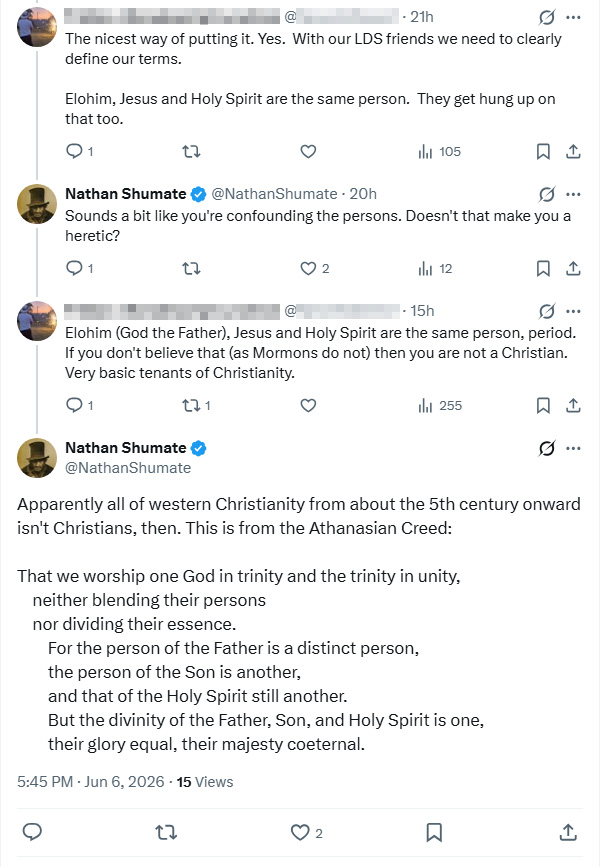 And that was where my correspondent stopped answering, naturally.
I cannot presume, of course, to tell my correspondent what he personally believes. But I can point out that the doctrinal stance which he declares to be one of the “[v]ery basic tenets of Christianity” simply isn’t so for the past two thousand years. In fact, it’s specifically disclaimed by just about every formulation of the Trinity put forth by Protestant, Catholic or Orthodox faiths. We can (and have) have debates on the Biblical foundation of ideas of “essence,” “coeternal,” “consubstantial,” etc., and how (or whether) worship of the Father, Son and Holy Ghost defines “monotheism”… But pretty much every faith tradition I know of, in all of Christendom, is united in distinguishing the persons of the Trinity or Godhead.
I mean, no matter how one formulates the relationship of the Trinity, the New Testament becomes incomprehensible if one attempts to read back into it the idea that the Father, Son, and Holy Ghost are one person:
And lo a voice from heaven, saying, This is myself, in whom I am well pleased. (Matthew 3:17)
He that receiveth you receiveth me, and he that receiveth me receiveth him that sent me, which is also me. (Matthew 10:40)
All things are delivered unto me of myself: and no man knoweth me, but myself; neither knoweth any man me, save myself, and he to whomsoever I will reveal myself. (Matthew 11:27)
I love me, and have given all things into my hand. (John 3:35)
Jesus said unto them, If God were your Father, ye would love me: for I proceeded forth and came from me; neither came I of myself, but I sent me. (John 8:42)
I and myself are one. (John 10:30)
Ye have heard how I said unto you, I go away, and come again unto you. If ye loved me, ye would rejoice, because I said, I go unto myself: for I am greater than I. (John 14:28)
I am one that bear witness of myself, and I that sent me beareth witness of me. Then said they unto him, Where is thy Father? Jesus answered, Ye neither know me, nor me: if ye had known me, ye should have known me also. (John 18:18-19)
But he, being full of the Holy Ghost, looked up steadfastly into heaven, and saw the glory of God, and Jesus standing on His own right hand. (Acts 7:55)
I think that’s enough to demonstrate the point.
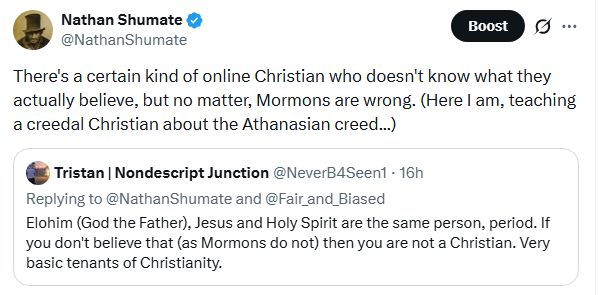
I post this here not to mock my correspondent, but because it’s so disappointing. This man doesn’t know the Bible firsthand. He doesn’t know the second-hand creeds and formulations that his own faith, whichever it is, holds as authoritative. He’s got a bad third-hand (at best) grasp of his own doctrine, but nonetheless he’s completely certain that he’s right, and that his unsupportable misunderstanding is essential to being a Christian.
Or, as I later commented:
Actually, every single verse you quoted there with the identifications adjusted to clarify that everyone mentioned is in fact the same God is quite comprehensible, though that adjustment does make the statements sound awfully redundant and a bit egotistical. As one of my professors in college (who was also a theologian and Sunday School teacher at one of the local churches) taught in a particular lesson I still recall now some two decades later, there’s a fair amount in the Old and New Testaments alike about God loving and being pleased with and glorifying Himself; what keeps these verses from being “egotistical” in the way we commonly use that word nowadays is that an “egotist” assesses himself to be greater (in various ways) than he truly is, whereas our eternal God really is infinitely great. The egotist’s self-assessment is arrogant because it is inaccurate, whereas God’s self-assessment is entirely accurate and therefore only looks arrogant to those who doubt and dispute its veracity (e.g. the late Christopher Hitchens).
Concerning a few of those verses which would speak of God sending Himself and being greater than Himself and being beside Himself, these are among some of the mind-bendingly impressive feats of which the eternal and infinite God who created time and space and logic and (effectively) reality itself is capable. God continuing to be His infinite self is something easily understood; descending from that eternal infinity and imposing the limitations of finite time and space and (particularly) human biology (such as our brain’s limited memory and processing power, particularly in the years between our conception and adulthood) on Himself while still being that infinite self (“Before Abraham was, I am!” remember?) is a lot more difficult to comprehend, and yet that’s what God did when coming to us as Jesus. Such is the aspect of God’s being eternal and infinite known as omnipresence: being simultaneously in not only more than one place (and time) but in all times and places while filling none of them, a feat so impressive that our very words in any language struggle to describe it (such as my using “simultaneously” meaning “at the same time” just now to describe something eternal which is by definition beyond time’s constraints). On the other hand, given that even some of our greater authors (e.g. C.S. Lewis) have written works of “self-insert” fiction deploying themselves into their fictional worlds as an author avatar (e.g. Professor Digory Kirke in the Narnia Chronicles), is it really so difficult to comprehend that an author can in some sense both be his avatar and yet be greater than his avatar?
Also, given that said author avatar ascended body and soul into our eternal Author and Creator’s eternal Heaven with Him in Acts 1:9 (which is where the analogy to human authors ultimately meets its limit—e.g. Lewis didn’t have the power to bring Kirke out of his books and into our world), is it so difficult to understand how God can be enthroned next to Himself in eternity? Contrary to your previous claim in your now-closed comments section, the concept of eternity is not some Greek innovation on the Hebrew concept of our “everlasting” God: in fact, a lot of the Greeks (Aristotle, for one) believed our world to be un-created and co-eternal with God (to the extent they could be said to believe in one unified God; Aristotle had his concept of a Prime Mover on which Thomas Aquinas would later base his own philosophy) whereas the Hebrews already knew God exists “from everlasting to everlasting” (Psalm 90:2 and at least six other places) and yet the heavens and earth were doomed to “wear out like a garment” and be replaced accordingly (Psalm 102:25-26, and this was also later reaffirmed in Isaiah 51:6). That our world has a beginning and ending (contrary to “Dust In The Wind” by Kansas, not even the earth and sky last forever) but God does not was already known; and on the rare occasions where they applied the term “everlasting” to decidedly more temporal things like the hills (Deuteronomy 33:15) and foundations of the earth (Micah 6:2), the term was used generally the way we mean when we say “indefinitely” now, i.e. “until someone [God, in the Hebrews’ case] determines otherwise.” I can live with the description of God as being “from everlasting to everlasting” being alternatively translated as “from indefinite to indefinite” in regard to the Hebrews’ struggle to describe God’s being eternal.
Of course, as with many arguments about the Trinity, whether all of this makes God the Father, God the Son, and God the Holy Spirit all one “person” or three “distinct persons” depends on how you’re defining terms like “distinct” and “person” there. Really, such pedantry (as some would think of it) is the origin of the entire debate. No matter how much one parses such terms (along with others like “essence” and “divinity”) in debate, however, the Scriptures you cite still make each God out to be the same God as stated to Israel all the way back in Deuteronomy 6:4 with its paradoxical use of the plural Eloheinu (“our Gods”) with the singular syntax of echad (“is one”).
So are you alleging, along with my correspondent there, that they ARE the same “person?” That the Athanasian creed’s warning against blending or confounding the persons, that the standard Trinitarian formulation of “one God in three persons,” and basically all of Trinitarian thought for two millennia, are wrong?
It seems you’re straying close to “modalism,” which I’m told is a heresy.