
[Another in the series of “Responding to Bumper Stickers,” or “Long Answers to Short Questions,” in which I try to give a Latter-day Saint response to a question or claim commonly lobbed against us on X.]
This installment isn’t an answer to a question or accusation; rather, it’s an explanation of linked concepts appropriate to many related conversations.
Exegesis literally means “a leading out.” It’s a word that doesn’t get much use outside of academic religious circles, but gets used plenty within them, where its meaning is to draw meaning out of a text — to read the text as it would have been intended by its author and understood by its primary audience, including explaining cultural assumptions which would have been presumed by its original audience but which are opaque now. (You can understand my use of “text” as a single verse, a passage, or an entire book or epistle — any block which can be read or compared as a unit.)
For instance, an exegesis of Mark 2:22 (“new wine into old bottles”) could explain that the “bottles” spoken of were actually leather wineskins, which stretched out as fermentation occurred; an old wineskin, having already been stretched out by previous use, wouldn’t have any elasticity to accommodate a new batch of fermenting wine, and would instead burst. Also, as the context of Jesus’ remark was criticism by the Pharisees and scribes, the implication understood from that example is that the “old wineskin” of the then-extant Jewish religious organization and hierarchy would not work to hold the “new wine” of Christ’s gospel.
The opposite concept is eisegesis, “a leading in.” This is when our pre-existing concepts and beliefs are read into the text without being there originally.
Note: This is not necessarily a problem if it does not argue that the text in question carries the eisegetical meaning as such, but only that the scripture’s re-purposing is metaphorically valid. For instance, using the account of David and Goliath as a metaphor for facing one’s overwhelming problems with trust in God is a benign eisegesis — it doesn’t say that this is what the scripture actually must mean (i.e., that Goliath is nothing but a metaphor for challenges), but that this is a meaning that the text can bear in giving concrete imagery to a less concrete problem.
On the other hand, here is a factually incorrect eisegesis: The once-common notion that the phrase “eye of the needle” in the synoptic gospels (through which a camel may or may not pass) referred to a smaller door in the gates of Jerusalem which was the only entrance when the gates were shut, through which a camel could fit only if its cargo was removed and if it crawled on its knees. In reality, no such door existed, and Pax Romana meant that Jerusalem’s gates were always open. This interpretive context was a later invention that was read back into Jesus’ hyperbolic statement about rich men entering heaven, maybe to make it seem a little softer and more forgiving.
Now, I didn’t tell you all this just so we all understand the definitions. The big issue is this:
There’s no such thing as 100% exegetical interpretation with no eisegesis.
For one thing, every exegesis runs the risk of being eisegesis. Compare the two examples above, the “new wine in old bottles” and the “eye of the needle.” Both interpretations rest upon information outside the text itself which presumably was held by the primary audience. The only problem is that the facts about leather wine-skins are true; those about the door in the gate of Jerusalem are false, and any interpretation which encompasses them is reading into the text meaning that was not intended originally.
An even bigger problem can result from the very reasonable practice of using other scripture as part of the interpretive context for any particular verse. Therefore, we take Paul’s teachings about faith and grace in Romans, and interpret it in the light of the other Pauline epistles (including Hebrews, of uncertain authorship), but also in the light of the Epistle of James. I’ve already written a whole post about this, but interpretation is necessary a qualitative and subjective activity, and involves decisions on what to privilege in one’s interpretive framework — which text to treat as loadbearing for another text. One can therefore resolve implicitly to interpret Text A in terms of Text B, even though Text B may not have been part of the context which the author of Text A was referencing.
But the biggest problem is unconscious eisegesis — when you don’t even realize what a priori assumptions from your theological framework that you’re bringing to your understanding of the text. And of course, it’s easiest to see this in someone who disagrees with you theologically.
For instance, a Latter-day Saint would say that several of the things affirmed by many creedal Christians as biblical are eisegetical rather than exegetical:
- The Bible is inerrant and whole, and the canon is closed.
- The Son is both co-equal to, and co-eternal with, to the Father.
- etc…
Someone who believes those two tenets may point to verses which can be used for support, but those who reject them can point to other verses for opposition. From where Latter-day Saints sit, both of these creedal doctrines are eisegetical to the Bible — you can maybe find some support for them in the Bible if that’s what you’re looking for, but you can’t unambiguously derive them from the Bible.
Of course, there are those who say that one shouldn’t “interpret” the Bible when one reads it, but those are the biggest unconscious eisegetes of all, because understanding any text is a process of interpretation; there is no way to look at little ink marks on paper and draw from them intentional meaning without interpretation. And we then end up with exchanges like this:
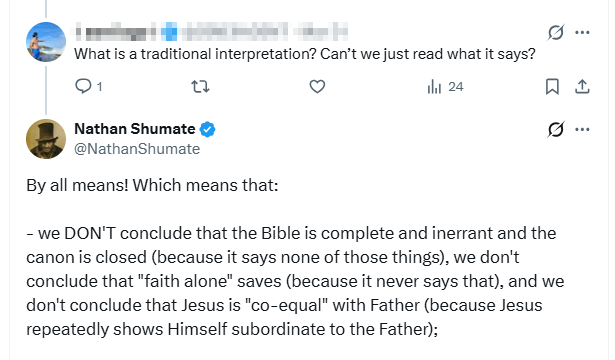
(There were no replies after this point in the conversation.)
My point isn’t that we can or should try to avoid eisegesis (even, as stated above, if that were possible), but that we should recognize our own eisegetical biases as much as possible, and realize when our disagreement is about our eisegetical baggage rather than the text we’re hanging that baggage on.