[Another in the series of “Responding to Bumper Stickers,” or “Long Answers to Short Questions,” in which I try to give a Latter-day Saint response to a question or claim commonly lobbed against us on X.]
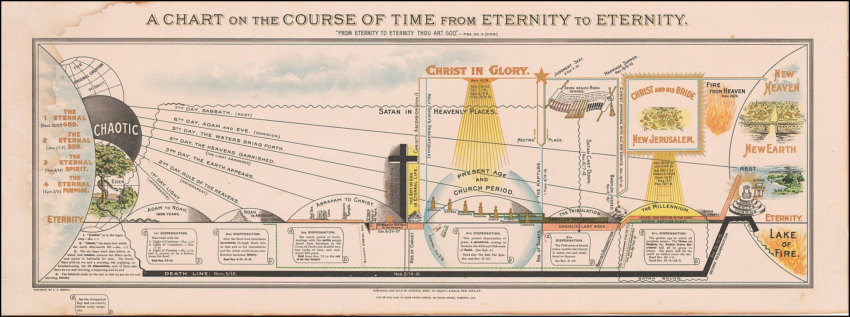
This one is as much a voyage of discovery as it is a plain answer. Someone “accused” me of being a dispensationalist, and I had to say that I don’t know if I am or not. The word “dispensation” is common in Latter-day Saint circles, mainly in referring to the era since the gospel of Jesus Christ was restored through Joseph Smith as the “dispensation of the fulness of times” prophesied by Paul. But I don’t know what the -ism specifically means in the taxonomy of protestantism, so I’ll have to figure it out as I go.
Let’s see. According to Wikipedia:
Dispensationalism is a Christian theological framework for interpreting the Christian Bible which maintains that history is divided into multiple ages called dispensations in which God interacts with his chosen people in different ways. It is often distinguished from covenant theology, the traditional Reformed view of reading the Bible. These are two competing frameworks of biblical theology that attempt to explain overall continuity in the Bible. The coining of the term “dispensationalism” has been attributed to Philip Mauro, a critic of the system’s teachings, in his 1928 book The Gospel of the Kingdom.
Which means, I guess, that I’ll also have to explore “covenant theology” by the time I’m done. Continuing from Wikipedia:
Dispensationalists use a literal interpretation of the Christian Bible and believe that divine revelation unfolds throughout its narrative. They believe that there is a distinction between Israel and the Church, and that Christians are not bound by the Mosaic Law. They maintain beliefs in premillennialism, Christian Zionism, and a rapture of Christians before the expected Second Coming of Jesus, whom Christians believe to be the Messiah, generally before the Great Tribulation.
Hm. Well, I certainly think there are many literal things in the Christian Bible — the more recent a specific book is, the less time there generally was between the events reputed to take place and the recording of such events, so I usually look at the more recent parts as more literal — and there definitely is a divine revelation unfolding through its narrative. I believe that there’s both a distinction between Israel and the Church and an overlap between them. I think it’s pretty widespread for Christians not to consider themselves bound by the Mosaic law, so I don’t know how that’s a distinctive feature of dispensationalism. I think that LDS teachings pretty solidly include premillenialism, at least a defined in capsule in Wikipedia. We definitely support the broad definition of Christian Zionism (that’s like half of The Book of Mormon). I don’t want to say that we believe in “the rapture” as such, just because that’s been developed in Christian culture so far beyond its mention in scripture that to most people it connotes a “Left Behind” situation.

That’s an awful lot of explanation of dispensationalism that doesn’t say anything about dispensations, though. Let’s see if I can find a meaty bit:
Dispensationalism is a Christian theological framework that views history as divided into distinct periods in which God interacts with mankind in specific ways. Scofield, in his Scofield Reference Bible, defined a dispensation as “a period of time during which man is tested in respect of obedience to some specific revelation of the will of God”.
Charles Ryrie took issue with Scofield’s definition as too simple, stating that such a definition opened the system to attack from nondispensationalists. Ryrie separates the term age from dispensation, stating that the two terms are not synonymous in meaning while defining a dispensation as “a distinguishable economy in the outworking of God’s purpose”. He further suggests that the defining characteristics of a dispensation are the distinct governing relationship in which God interacts with mankind during that period, and the resulting responsibility placed upon mankind in that period.
Evangelical Christians generally agree that there are distinct periods in God’s plan for humanity. Dispensationalist theologians tend to hold “a particular view of the parallel-but-separate roles and destinies of Israel and the [Christian] church”, with a “careful separation … between what is addressed to Israel and what is addressed to the church. What is addressed to Israel is ‘earthly’ in character and is to be interpreted ‘literally’.”
Well. I’ve got a bunch of yes-but-also-no comments from a Latter-day Saint perspective, mostly stemming from underlying assumptions separating protestantism and Latter-day Saints.
I wouldn’t say that we agree with Scofield’s definition a dispensation as “a period of time during which man is tested in respect of obedience to some specific revelation of the will of God,” and I really don’t see Ryrie’s definition as a clarification (it just introduces a whole bunch of other terms which need specific definitions to make sense). A normal LDS definition, I think, would be that each dispensation is (a) begun by God seeing the necessity to reveal Himself again to a prophet as a direct renewal of His doctrine and His authority, and (b) is almost always preceded by an extended period in which essentials of that doctrine and authority have been lost.
Thus, one would speak of a dispensation of/to Adam (his would be the only one to which (b) would not apply). Noah would likely be considered the head of a dispensation, in that his prophetic authority was literally all that his children would have had after the flood. I suppose one could say that Abraham received a dispensation; I don’t think we know enough of the environment he came from to know how much of his knowledge of God was a break from the culture he came from. Moses definitely was at the head of a dispensation, as the Lord revealed an entire covenant anew through him to the children of Israel, who apparently had retained only some vestige of the revelation of God to Abraham, Isaac and Jacob.
Jesus definitely stood at the head of a dispensation. But Paul, as well, had a specific and overlapping dispensation by direct revelation to bring Christianity to the Gentiles. So while it’s easy to think of each dispensation as a specific era, it’s not strictly accurate.
(And of course, we believe that Joseph Smith stood at the head of this, the dispensation of the fulness of times.)
But I think the bigger difference between the protestant and Latter-day Saint conceptions of a “dispensation” is the idea that, with each dispensation, God necessarily communicates in a different fashion or with a different focus. Here’s a chart from Wikipedia showing the most common protestant dispensationalist conceptions:
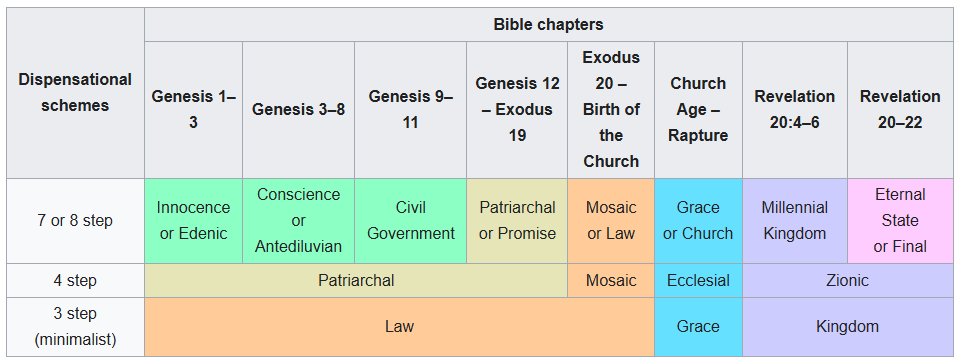
I think most Latter-day Saints would hold that the only dispensation which was substantively different from the others was the Mosaic one, because we believe that the Law delivered to the Israelites was a distinctly lesser one than what God would have revealed from Sinai had the Israelites been ready to receive it. But then, I know we’re unique in that way; we believe that Adam, Noah, Abraham, etc., knew of the future mission and atoning sacrifice of the Son of God and held a higher priesthood authority than that of Aaron. (Obviously, the means to administer the gospel of Jesus Christ would have been structurally different in earlier eras; you can’t have a “church” in the modern conception in a society composed of widely separated agrarian family groups.)
It also looks like the other (related) significant feature of protestant dispensationalism regards the relationship between pre-Christian Israel and the Christian Church. Wikipedia obviously only gives a summary:
Believing that the Old Testament promises to Israel await fulfillment, dispensationists link biblical Israel to the modern state of Israel, viewing its establishment as fulfillment of biblical prophecies concerning Israel. Christian Zionism has made evangelical Christians some of the most ardent supporters of the State of Israel in American politics.
The Church, on the other hand, consists of all saved individuals from the “birth of the Church” in the book of Acts until the time of the rapture. Classic dispensationalists refer to this period as a “parenthesis”, a temporary interlude in the progress of Israel’s prophesied history when God has paused his dealing with Israel and is dealing with his Church.
That’s short enough that I could easily misunderstand what is meant by every part of it. I guess the safest tack is to state a normative Latter-day Saint understanding of related issues, and let the reader decide which is in agreement and which is in conflict:
We believe that the children of Israel still have claim on the covenants of the Lord as His covenant people. We also believe that in the time after the atonement of Jesus Christ, the covenant of Israel has been thrown wide, with those brought to Christ by baptism becoming recipients of those promises as well. We refer to our missionary work as “gathering Israel” — bringing into the covenant those who are not of literal Hebrew descent, and re-establishing the covenant for those who are.
Maybe exploring “covenant theology,” which Wikipedia lists as the Pepsi to dispensationalism’s Coke, would help me understand.
[reads Wikipedia]
Well, there’s a lot there in the summary descriptions of covenant theology that I would agree with as well as disagree. For instance:
What unifies all the act in the “greatest drama ever staged” is that they are expressed in the Bible through the concept of covenant. (Daniel R. Hyde)
I wholeheartedly agree. On the other hand:
The standard form of covenant theology views the history of God’s dealings with mankind, from Creation to Fall to Redemption to Consummation, under the framework of three overarching theological covenants: those of redemption, of works, and of grace.
Yeah, no. I think this partially relies on what Latter-day Saints would see as a misapprehension of the relationship of works and grace (I’ve written a whole post on that) and a lack of awareness that, as referenced above, the gospel of Jesus Christ had been revealed to Adam and his posterity from the beginning). The full covenant is one of grace and redemption, of faith expressed by works; the lesser temporary covenant of the Mosaic law instituted the observances of that law to be, as Paul said, a temporary schoolmaster to bring us to Christ.
So, are Latter-day Saints dispensationalists or covenantalists? Yes. And also no. I’m sure that dispensationalists wouldn’t consider us part of their camp, and neither would covenantalists.