The late Stephen Gay Gould is one of my favorite essayists; he combines subject matter about the vagaries and intricacies of natural history with an engaging delivery that showed him to be a well-rounded, endlessly curious man.
But of course he (a liberal atheist-leaning agnostic cultural Jew) and I (a believing Latter-day Saint and political conservative) disagree on many things. I certainly don’t challenge him on factual matters in which he’s1All right, it’s too hard to figure out which references should be in past tense and which in present; I’m just going to refer to him in present tense. Unless I don’t. the expert by orders of magnitude, or even largely over what those factual matters mean, but on some of the underlying assumptions which he will occasionally reference as axiomatic. It usually takes someone who doesn’t hold with the same assumptions to point out what you didn’t even know you were assuming.
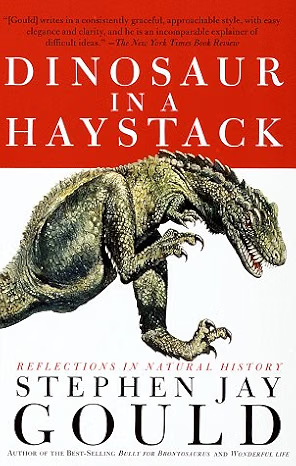 The present occasion comes from reading his 1996 essay collection Dinosaur in a Haystack, and specifically the essay “Four Antelopes of the Apocalypse,” which revolves around the blaauwbock or blue antelope, the first large animal to go extinct in the modern age after being scientifically documented; it was “first mentioned by a traveler in 1719, not formally described until 1766, and then exterminated in 1799” (p. 275).
Why? a combination of novelty — its pelt was described as sky-blue (although none of the handful of extant skins have retained the color) — and ecological fragility — “most reports fix its range [when first encountered by Europeans] to a tiny area, perhaps no more than sixty miles east-west by forty miles north-south” (278).
As Gould says, “No large mammal with so limited a range can long endure” (278).
One would expect a paleontologist to be phlegmatic about the predictable extinction of a random species; wistful, perhaps, about the just-beyond-our-reach status of a species extant so recently which lives now only in a handful of ill-maintained specimens, but realistic about the fact that extinction does come for all (the existence of paleontology depends on that reality), and it often must come at the hands (or teeth, or claws, or wombs) of another species.
And yet, Gould describes the blaauwbock’s extinction as being “by human malfeasance” (281), without an particular argument to establish that description. In fact, he includes this particular extinction as a single example of those species which “have succumbed to human rapacity” (273), and describes curators of natural history as “often hold[ing] the only palpable remnants of greatness that should still walk among us” (273).
Note the word: Should.
In Gould’s order of things, there is apparently a moral ought to the survival of particular species — that is, species for which humans were instrumental in their extinction. Despite the point of several essays in this collection (and many others in other volumes) being that the human species is one within and not apart from the natural order — an order which is guided by no “arrow of history” leading to anything being “better” by any metric except simple survival in an environment — there is still a moral ought which Gould treats as axiomatic, and yet which remains entirely unexamined in his explications of natural history.
This is not the only instance in which a moral ought punctuate Gould’s essays — they are very frequent, actually — but the specificity of this one stands out, because it attributes an axiomatic moral value to something which is certainly less than certain to at the very least a large plurality of people: That a species’ extinction, if humans were involved, is a moral failing in a way that extinction due to any other species is not.
That specific moral ought caught my attention, and set me to thinking of the place of morality and ethics in general in Gould’s worldview. His longest complete statement on morality in this volume comes from another essay:
[T]he ethical realm of ‘oughts’ cannot be logically specified by the factual ‘is’ of the natural world…. [W]hen I stand against Nazi policy, I must do so as everyman — as a human being. For I win my right to engage moral issues by my membership in Homo sapiens — a right vested in absolutely every human being who has ever graced this earth, and a responsibility for all who are able. (318)
That confuses me, coming as it does not only from a presumptive non-theist, but one whose conception of Homo sapiens within the randomly evolved biological world forestalls the idea some have posited, as a halfway measure, of a non-theistic-dependent objective morality. He makes that explicit here: “…[M]oral feeling is an evolutionary latecomer, imposed by human consciousness upon a much older mammalian pattern” (60). And yet, even as he defines matters of morality as beyond scientific examination or explanation (318), he still obviously treats them as, in some sense, objective; otherwise, the moral standards of those who inadvertently caused the ecologically fragile blaauwbock would be as valid as own, which equivalence he does not for a second entertain.
Any atheist or atheism-adjacent reader may simply lump all of this into a strawman of which theists (in particular Christians) are incessantly accused: “You think that people can’t be good without believing in God!” Of course not; I will energetically declare that I think Gould was a good man, no matter what particulars I may disagree with; he certainly seems, by the solely textual one-way interactions I’ve had with him, to have had firm conceptions of good and evil, and a will to support and encourage good at the expense of evil (his entire book The Mismeasure of Man is devoted to pointing out and condemning the misuse of IQ tests as a justification for self-serving racism).
I certainly believe that atheists can be good, and can be concerned with consciously advancing good, without a belief in God. Even atheists of a thorough-going naturalistic worldview can do so.
What they can’t do is justify it. Their moral sense, as strong as it is, cannot be harmonized with an entirely materialistic conception of human beings as the result of nothing but biological accidents winnowed out by the natural selection of survival. Gould’s declaration that humanity is “freighted by heritage, both biological and cultural, granting us capacity both for infinite sweetness and unspeakable evil” (318) is a non sequitur; biology alone cannot lead to evil.
For those who have read this far without comprehending, I am not stating the the idea of biological evolution is incompatible with Christianity, theism in general, or objective good and evil. Evolution certainly seems from the physical evidence to be the way in which all of the countless species in the Earth’s geological history came and went, and natural selection to be the main mechanism of such evolution; while I admit the technical possibility of it being wrong, I find that as vanishingly unlikely as that we will find that the law of gravity to to be illusory. What I am stating is that biological evolution, and a thoroughly materialistic/naturalistic model of reality, are not sufficient to explain axiomatic and objective good and evil.
However, being a Latter-day Saint, my theology places Gould for the past 24 years in an environment in which he is able to see and acknowledge the objective moral dimensions which make the universe of his former declared materialism seem a paltry thing indeed. And if I understand his character at all from readying his books, he is absorbing that greater perspective with joy and enthusiasm.
I love this piece. I am familiar with Gould’s writings, as well. I’ve also read “Justice for Hedgehogs,” by Ronald Dworkin, who argues for “axiomatic” moral beliefs, in spite of, as he puts it, no one having measured the spin and charge of “morons” (q.v. electrons and protons) that should allow us to measure morality.
Dworkin demonstrates how he builds a self consistent axiomatic framework of moral beliefs. As you say, its foundations are sort of free-floating, detached from an externally imposed edict, because of Hume’s Guillotine: You cannot get from is to ought.
I don’t believe that you’re correct in crediting religion with creating moral beliefs. People need moral beliefs to live together, and when you get enough people in one place someone has to write the moral beliefs down in case someone disagrees. It’s as simple as that.
Helge! It’s been a while.
Just for personal taxonomy (I know these aren’t the generally accepted definitions, but I use them just to make the distinction clearer in conversation), I usually use “ethics” to denote a rationally determined system of utilitarian “rules of the road” for a functioning society; they usually prioritize fairness and justice or loyalty and patronage because a principle-based system of ethics is easier to understand and maintain than having an arbitrary rule for every discrete situation. That, I think, maps well to what you describe in your last paragraph. “Morality,” by contrast, I use to denote the non-rationalized concepts of “good” and “evil.”
The kind of axiomatic moral determinations Gould uses — that some things are at their core EVIL, not just unjust or inequitable — certainly looks like a different beast. If all he meant were the kind of generally agreed-upon social standards that you describe in your last paragraph, then he would have no cause to say that the generally agreed-upon social standards of another social milieu which diverge from his own — trophy-hunting in the 1700s, racism in the American South, etc. — are illegitimate or wrong, because that definition of utilitarian moral/ethical construction can’t privilege one sufficient structure over another.
I don’t know that I ever said, or even implied, that religion CREATES moral beliefs, if by that you mean that either a person’s specific moral standards, or more importantly the entire concept of moral value itself, are downstream from imposed (external to the person) moral dogma. In fact, I think the opposite is implicitly true, and it certainly seems to be the unexamined subtext of Gould’s own writings: That he accepted morality (the idea of there being actual good and actual evil, the substrate to judging any particular act or idea as itself good or evil) as an objective reality, which nevertheless cannot be accounted for in the strict materialism which was his conscious worldview.
I haven’t read Dworkin, but from how you described his framework, it doesn’t appear to be the kind of structure that animated Gould’s moral sense. One cannot rationally construct one’s own free-floating moral framework, and then judge people in another cultural milieu two centuries before against it.