[Encompassing the “Jesus and Satan” post I made the other day, I think I’ll start a series — maybe called “Responding to Bumper Stickers,” maybe called “Long Answers to Short Questions” — in which I’ll try to give a Latter-day Saint response to a question or accusation commonly lobbed against us on X. It’s always easier and faster to post an accusatory question than to competently answer it, resulting in a bunch of TL;DR replies on X; nevertheless, the time I spent typing a response shouldn’t go to waste, and it may be a good resource for someone else who wants an answer at their fingertips.]
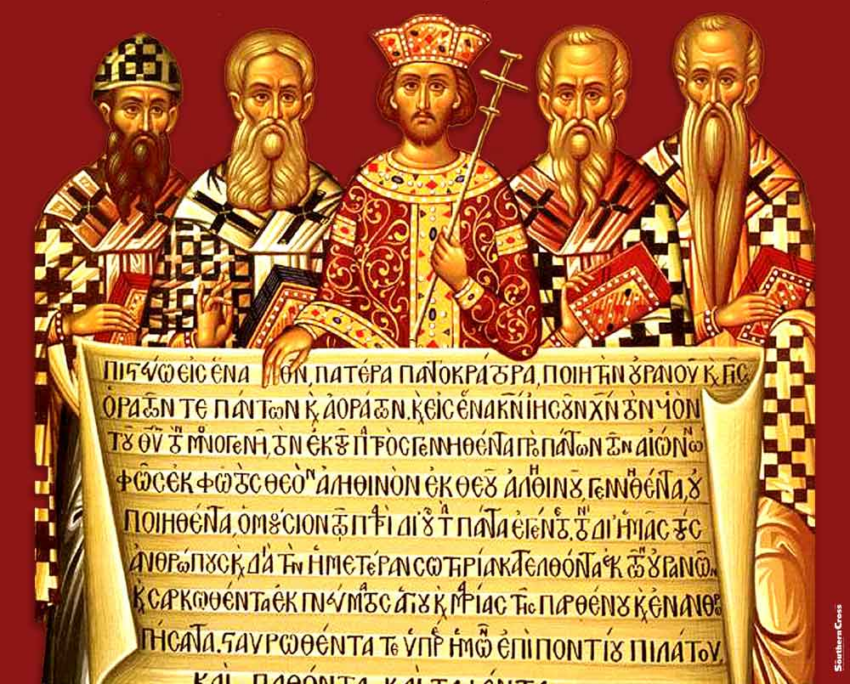
Frequently, it’s alleged that if Latter-day Saints don’t confess the creeds (usually meaning the Nicene and Athanasian creeds), that we’re not Christians.
Part One: The Structure
First, if the person so declaring is a Protestant (and thus presumably holds to sola scriptura), it becomes a little hard to understand how someone who holds to nothing beyond the pages of the Bible simultaneously holds these post-biblical documents to be authoritative.
If the follow-up is that every doctrine taught in the creeds is clearly taught in the Bible, then the question becomes why it had to be restated several centuries later by contentious councils of bishops to declare other Christians (who also saw their beliefs as deriving from the Bible) to be heretics.
This is more fundamental to the discussion than any of the doctrines described in the creeds: if being a Christian were dependent upon confessing a prescribed statement of doctrine, then the necessity of such a list would be even more clearly taught in the New Testament than the specific contents of such a list.
I mean, I have trouble with the idea that a man can meet the Savior at the final judgment, who had spent his life trying his best to follow His teachings as best he understood and to understand Paul’s teachings of what fruits faith should yield in his life, only to have Jesus say, “Sorry — yes, so sought to be faithful to me, but you believe the wrong things about me, so off to Hell you go.”
(The response I’ve sometimes seen to that is “Mormons have creeds too!” That claim doesn’t hold upon further examination. The only two documents to which that could conceivable refer are the Articles of Faith, which was an outward-facing, descriptive list of core LDS beliefs, not a prescriptive list to which members declare adherence — or the temple recommend questions, which are (a) modified from time to time, and thus were never meant as a core statement of doctrine, (b) remarkably short on doctrinal specifics, instead concentrating on behaviors befitting a faithful life, and (c) not meant to be the definition of “Christian” for any audience.)
Part Two: The Doctrine
To be fair, Latter-day Saints don’t have a problem with most of the doctrines stated especially in the Nicene Creed, although allowances must be made for understanding of terms in a different language composed over fifteen hundred years ago.
(I point out in passing that the lines “…In one Holy, Catholic, and Apostolic Church. I acknowledge one baptism for the remission of sins.” were a sticking point between Catholic and Protestant Christians from the time of the Reformation until the last century or so, when the spirit of ecumenicism finally — and sometimes reluctantly — brought most of both factions to admit that, fine, you guys are Christians too.)
Here is where the doctrine of the Nicene Creed meets most resistance from Latter-day Saints: That Jesus is declared to be “consubstantial with the Father” (some English versions have it “of one essence with the Father”). The Athanasian Creed spends a lot more words on defining this relationship (and, again, declaring it absolutely necessary for Christian faith), using phrases like “Neither confounding the persons, nor dividing the substance,” “the glory equal, the majesty co-eternal,” “three persons are co-eternal, and co-equal,” etc.
And yes, I’m familiar with the prooftexts used to support this, mainly the first half-dozen verses of the Gospel of john.
However.
I would say that if we’re trusting to exegesis (that is, reading from the scriptures) rather than eisegesis (i.e., reading into the scriptures), then our understanding of the relationship of the Father and the Son needs to encompass and account for these expressions of a hierarchical relationship:
- Jesus says that His Father is greater than He is (John 14:28).
- Jesus frequently defers to His Father (lots of examples in John: 5:19, 5:30, 6:38, John 12:49-50…)
- Jesus frequently demonstrates that His will is separate from the Father’s, most especially in His declaration from the Garden of Gethsemane: “Not my will, but thine be done.”
- Even the words chosen to describe their relationship — “Father” and “Son” — have as their most obvious characteristic a hierarchical meaning, both in authority and in time.
- When describing his oneness with the Father, Jesus explicitly asserts that this can also be the way in which His disciples are one with both Him and the Father (John 17:21).
- And upon His resurrection, He again describes His relationship to the Father as being analogous to His disciples (actual or potential) relationship to the Father (John 20:17).
None of this is meant to disprove John 1, but only to demonstrate that our understanding of the nature of the Father and the Son (and the Holy Ghost, of course) needs to be broad enough to accept both the citations that are cited as proof of the the creedal definitions of the Trinity and those I listed above.